
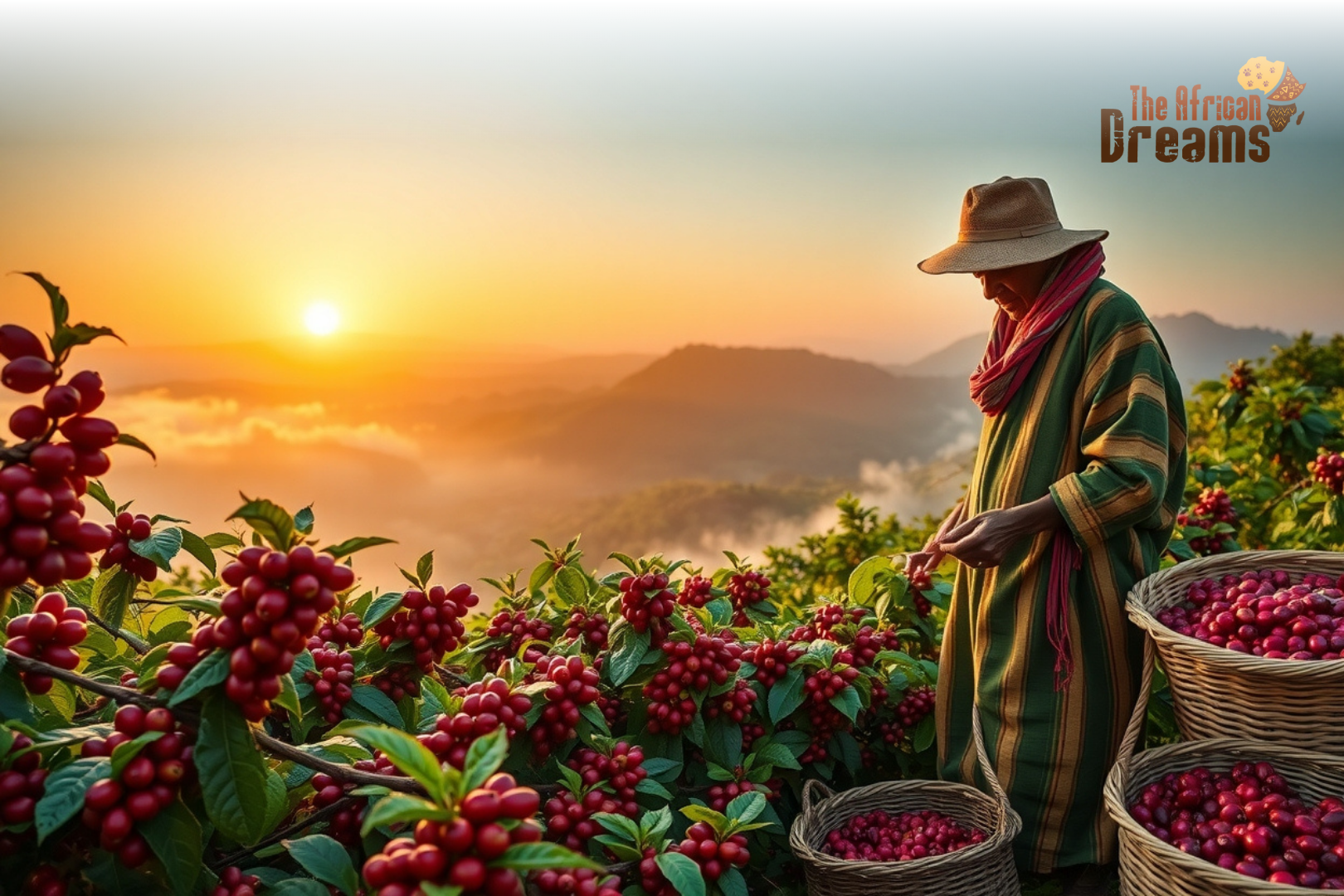
In the green highlands of Ethiopia, a goat herder named Kaldi noticed something strange. His goats were full of energy and leaping around after eating bright red cherries from a bush. Curious, he tried the cherries himself and felt a boost of energy. Kaldi shared this discovery with a monk, who used the cherries to make a drink that kept him alert during prayers. This simple event marked the start of coffee’s journey.
Today, in Ethiopia, coffee is more than a drink—it’s a part of life, a tradition, and a key to the livelihood of millions. It contributes approximately 30-35% of the nation’s foreign income, supports millions of livelihoods, and serves as a crucial driver of economic development.
Current State of Coffee Production in Ethiopia
Ethiopia’s coffee industry plays a vital role in its economy and culture. In the 2023/24 fiscal year, the country produced around 8.35 million 60-kilogram bags of coffee, equal to about 501,000 metric tons. Coffee farming provides income for about 25% of the population, showing its importance to millions of families.
Ethiopia set a record in 2023/24, earning $1.43 billion from coffee exports—a 7.5% rise from the previous year. The country exported 298,500 tons of coffee, with June 2024 alone contributing 46,000 tons and $218 million, the highest monthly figures ever.
Regions like Sidama, Yirgacheffe, and Harrar produce coffee with unique flavors, making them popular worldwide. Ethiopia’s climate and traditional farming methods create coffee that stands out globally. However, challenges such as poor infrastructure and limited market access remain. Improving these areas will help Ethiopia maintain its leading position in coffee production and exports.
Market Dynamics of Ethiopian Coffee
Global Demand for Ethiopian Coffee
- Ethiopian coffee is highly valued for its quality, particularly its specialty and organic varieties.
- Growing interest in ethically sourced coffee has boosted international demand for Ethiopian beans.
- Coffee from regions like Yirgacheffe and Sidama is a favourite among global consumers.
Price Volatility
- Fluctuations in global coffee prices affect the income stability of Ethiopian coffee farmers.
- Dependence on international markets makes the industry vulnerable to economic shifts.
- Diversifying markets and improving price stability are critical for long-term growth.
Domestic Market Trends
- Local consumption accounts for nearly 50% of Ethiopia’s coffee production.
- The cultural significance of coffee ceremonies fuels steady domestic demand.
- Ethiopia balances its dual identity as both a producer and a consumer market.
Certification and Branding
- Certifications like Fair Trade and Organic increase the global marketability of Ethiopian coffee.
- Investments in certification programs can increase profitability for smallholder farmers.
Major Coffee Varieties and Growing Regions:
Ethiopia, known as the birthplace of coffee, grows a wide variety of Arabica coffee. Each region has its unique coffee flavours, shaped by the climate and geography.
- Yirgacheffe: This coffee variety hails from the Gedeo Zone in southern Ethiopia. It is celebrated for its floral and citrus notes, often described as having a tea-like quality. This variety is typically wet-processed, producing a clean and bright flavour profile.
- Sidamo: Originating from the Sidama region, this coffee is known for its rich, full-bodied flavour with notes of berries and citrus. The region’s high elevations and optimal climate contribute to the coffee’s unique characteristics.
- Harrar: Grown in the eastern highlands, Harrar coffee is distinguished by its fruity and wine-like flavours, often accompanied by a heavy body and complex aroma. It is typically dry-processed, enhancing its bold flavour profile.
- Limu: Sourced from the southwestern regions, Limu coffee offers a balanced and clean cup with subtle spice notes. It is usually washed, resulting in a mild acidity and smooth flavour.
Ethiopian coffees are processed using natural (dry) and washed (wet) methods. The natural process involves drying the coffee cherries in the sun, imparting fruity and wine-like characteristics, as seen in Harrar coffees. The washed process, more common in regions like Yirgacheffe and Sidamo, involves removing the cherry pulp before drying, resulting in cleaner and brighter flavour profiles.
Challenges Facing Ethiopia’s Coffee Sector
Climate Change
Rising temperatures and unpredictable rainfall are making coffee farming harder. If no action is taken, Ethiopia could lose up to 60% of its coffee-growing areas by 2050.
Infrastructure Problems
Poor roads make transportation slow and expensive. Lack of proper storage and processing facilities affects the quality of coffee for export. Upgrading infrastructure can help reduce costs and improve productivity.
Farmer Struggles
Many small-scale farmers face low yields due to outdated methods and lack of training. Farmers often don’t earn enough because they have little control over prices.
Market Competition
Ethiopia faces stiff competition from countries like Brazil and Vietnam. Weak branding and limited promotion reduce its visibility in global premium coffee markets.
Why Investors Should Invest in Ethiopia’s Coffee Sector
Strong Heritage and Global Recognition
- Ethiopia is the birthplace of coffee, with its high-quality arabica beans renowned worldwide.
- Unique coffee varieties like Sidama and Yirgacheffe are in high demand and fetch premium prices.
Rising Global Demand
- The demand for speciality and organic coffee is growing steadily.
- Ethiopian coffee’s distinct flavours make it a top choice for international buyers.
Opportunity for Value Addition
- Most of Ethiopia’s coffee is sold as raw beans. Investing in roasting, packaging, and branding can bring higher profits.
- Processed coffee exports can help Ethiopia compete better in global markets.
Government Support
- Ethiopia provides tax benefits, incentives, and backing for agricultural investments.
- Collaborations with global organisations aim to improve infrastructure and boost market access.
Available Workforce and Market Potential
- Millions of people depend on the coffee industry, providing a ready and skilled workforce.
- A strong domestic market complements international demand, ensuring multiple income streams.
Case Study: Oromia Coffee Farmers Cooperative Union (OCFCU)
The Oromia Coffee Farmers Cooperative Union (OCFCU) is a shining example of how working together can transform the lives of coffee farmers in Ethiopia. This union has helped small farmers earn more, access better markets, and improve their communities.
Formation and Growth
OCFCU was created to address the challenges faced by coffee farmers in Oromia, including low prices and limited market access. By bringing many small cooperatives together, the union reduced middlemen, giving farmers a bigger share of profits.
Economic Impact
- Exports: OCFCU has expanded globally, exporting Ethiopian coffee to countries like the U.S., Germany, and Japan. By 2014, it was Ethiopia’s top organic coffee exporter and the second-largest Fair Trade coffee exporter. (Wikipedia)
- Farmer Earnings: The union returns 70% of profits to its farmers. By 2014, they had shared $3 million in dividends, greatly improving livelihoods.
Social Impact
- Infrastructure Projects: OCFCU has built schools, health clinics, roads, and water systems, making life better for its members.
- Job Creation: By 2014, it employed over 2,000 people, boosting local economies.
Quality Recognition
OCFCU’s coffee earned international praise, winning first place at the 2012 Coffee of the Year Competition out of 250 entries.
Certifications
With certifications like Fair Trade, Organic, and Rainforest Alliance, the union sells to premium markets. By 2020, 48 cooperatives were Fair Trade certified.
Conclusion
In a quiet Ethiopian village, a farmer carefully tends to his coffee plants, following traditions passed down through generations. Each coffee bean holds a story of culture, hard work, and the country’s deep connection to coffee. From the lush hills of Sidamo to the valleys of Yirgacheffe, Ethiopian coffee is more than a crop—it’s a part of life.
These beans travel the world, bringing unique flavours like the floral Yirgacheffe and the bold, fruity Harrar. Every cup reflects the dedication of Ethiopian farmers and the rich heritage behind the coffee.
For Ethiopia, coffee links the past to the future. It provides a livelihood for millions and showcases the country’s unique identity on the global stage. From the farmer’s hand to coffee lovers around the world, Ethiopian coffee tells a story of tradition, resilience, and opportunity.

0 Comments