
Introduction: Uganda’s Processed Matooke Flour
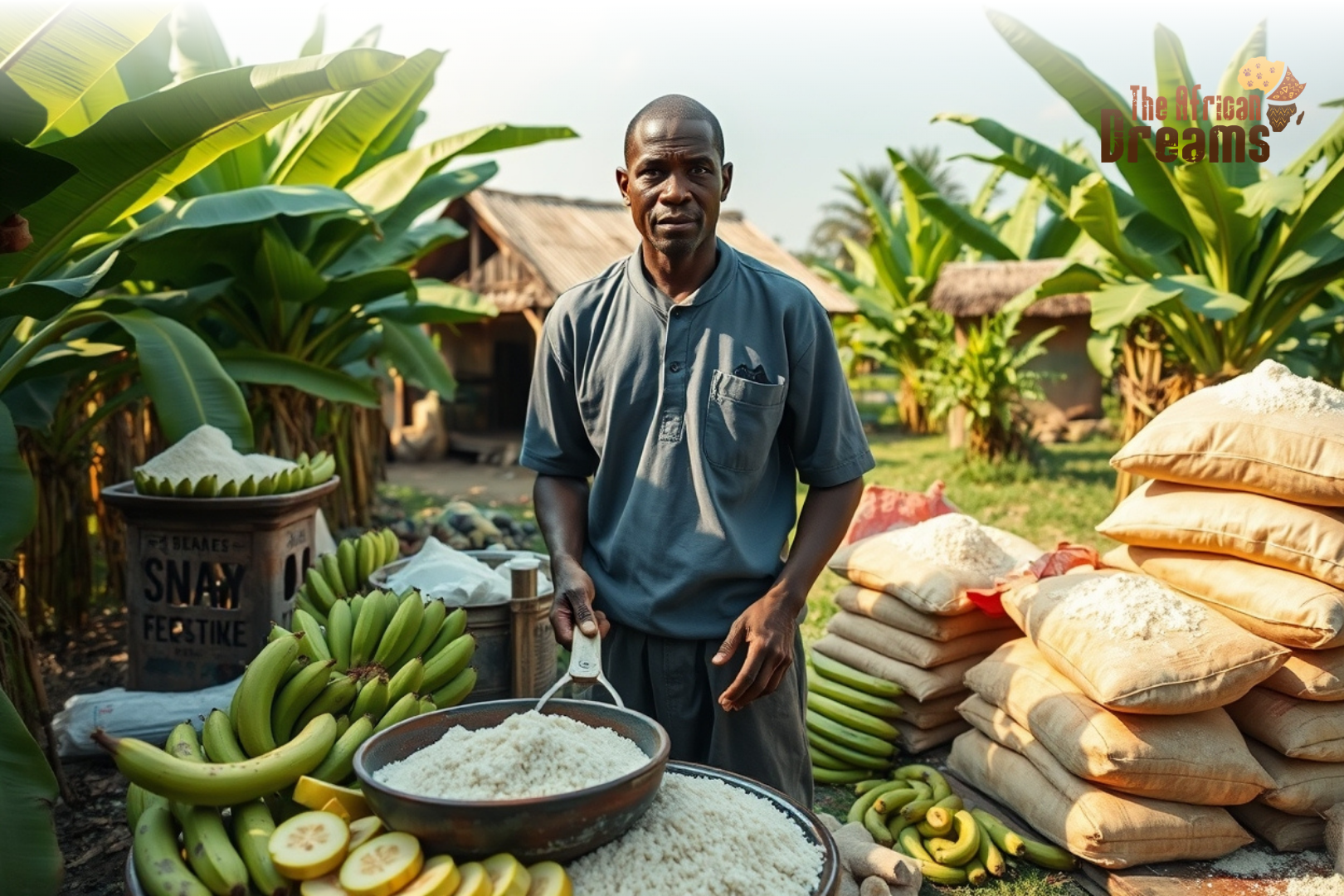
Winfred Kagwa tripled his earnings by producing processed matooke flour. This man from Western Uganda was tired of sharing revenues with middlemen. Bypassing those beneficiaries of his hard-earned money, he directly sells matooke flour to a chain shop in Kampala. Now, as he takes the whole share of his product, he’s inspiring the other local farmers engaged in similar businesses.
But his success story left some questions unanswered. If you’re wondering about the boost in his earnings, which has tripled, you can read this article to get the full story. Moreover, if you are looking to invest in Uganda’s processed matooke production, this article is a must-read.
So, let us give you a tour of the realm of Uganda’s processed matooke flour.
Article Highlights
Uganda runs low on producing matooke; yield can be made 58% more with proper implementation of resources.
Only 20% of the produced bananas are supplied to the export market, while 70% is consumed locally, and 10% is for local market sale.
Commercial processing of Uganda’s processed matooke into flour is crucial to controlling banana diseases and keeping a stable supply chain.
What is Uganda’s Processed Matooke and Matooke flour?
Matoke is plantain or green bananas, commonly known as Matooke in Uganda. East African countries are overwhelmingly eating it as a staple food. Unlike the common species of bananas, which turn yellow when ripe, matooke remains green because of its high amount of starch.
It’s a popular dish in Uganda, and being a great source of vitamins and minerals, it is consumed as a staple food by more than half of the people in Uganda. Matooke needs less effort to prepare, as you can eat it by boiling, steaming, frying, or even roasting. The food is rich in vitamins B6 and C, fibre, and potassium.
And, Uganda’s processed matooke reflects the conversion, sorting, and transformation into several value-added products. One of the states of processed matooke is flour. Ugandan people consume matooke in several ways, and flour is one of them.
Why Uganda’s Processed Matooke Flour is Significant
Uganda’s processed matooke flour is significant because
- It adds extra value to its original price.
- It remains fresh for a long time compared to fresh matooke.
- It is used in cooking additional dishes,
- Aids the farmers in reducing post-harvest losses, and
- Also provides them with a stable income source.
Producing Areas of Uganda’s Processed Matooke
Uganda is at the top in consuming bananas, about ½ kg per day per person. But the interesting fact is that the number is 1kg per person in the matooke-producing areas.
Though only 20% of the produced matooke goes overseas, the potential of this sector is huge. The more the farmers can grow it, the higher they can send the product for exporting.
Uganda produces over 10 million tons of matooke each year, 70% of which is consumed locally. So, the product is not so export-oriented. However, investment from outside the country can ensure a boost in production as well as export value.
Challenges in Matooke Production & Solutions
The influence of middlemen on banana processing greatly affected farmers for many years. Farmers couldn’t earn over 10% of the market value of produced matooke while the middlemen grabbed the largest share.
Matooke yield is suffering from low production in Uganda. The current yield is about 5-30 tons per ha, while the attainable yield can reach up to 70 tons per ha in a year.
1. Less investment and Non-commercial Farming: Low productivity is mainly caused by less investment and non-commercial farming. Only the smallholders are engaged in cultivating the crop for subsistence.
2. Climate Change, Poor Soil, and Pests: Other factors are common to all varieties of crops in Uganda. For example, the decline in productivity is caused by climate change, soil fertility, soil moisture, and pests such as banana weevils and nematodes. Besides, diseases like Banana Xanthomonas Wilt (BXW) and Black Sigatoka are also key challenges.
3. Rapid Urbanization, Technical Deficiency, and Poor Agricultural Practices: There are more challenges on the road. Rapid urbanization, technical deficiency, and poor agricultural practices are all contributing to the suffering in production.
However, investment and commercial farming with advanced production practices can reduce the gap and overcome the odds to ensure high productivity and yield.
Uganda’s Processed Matooke: A Better Situation is on the Rise
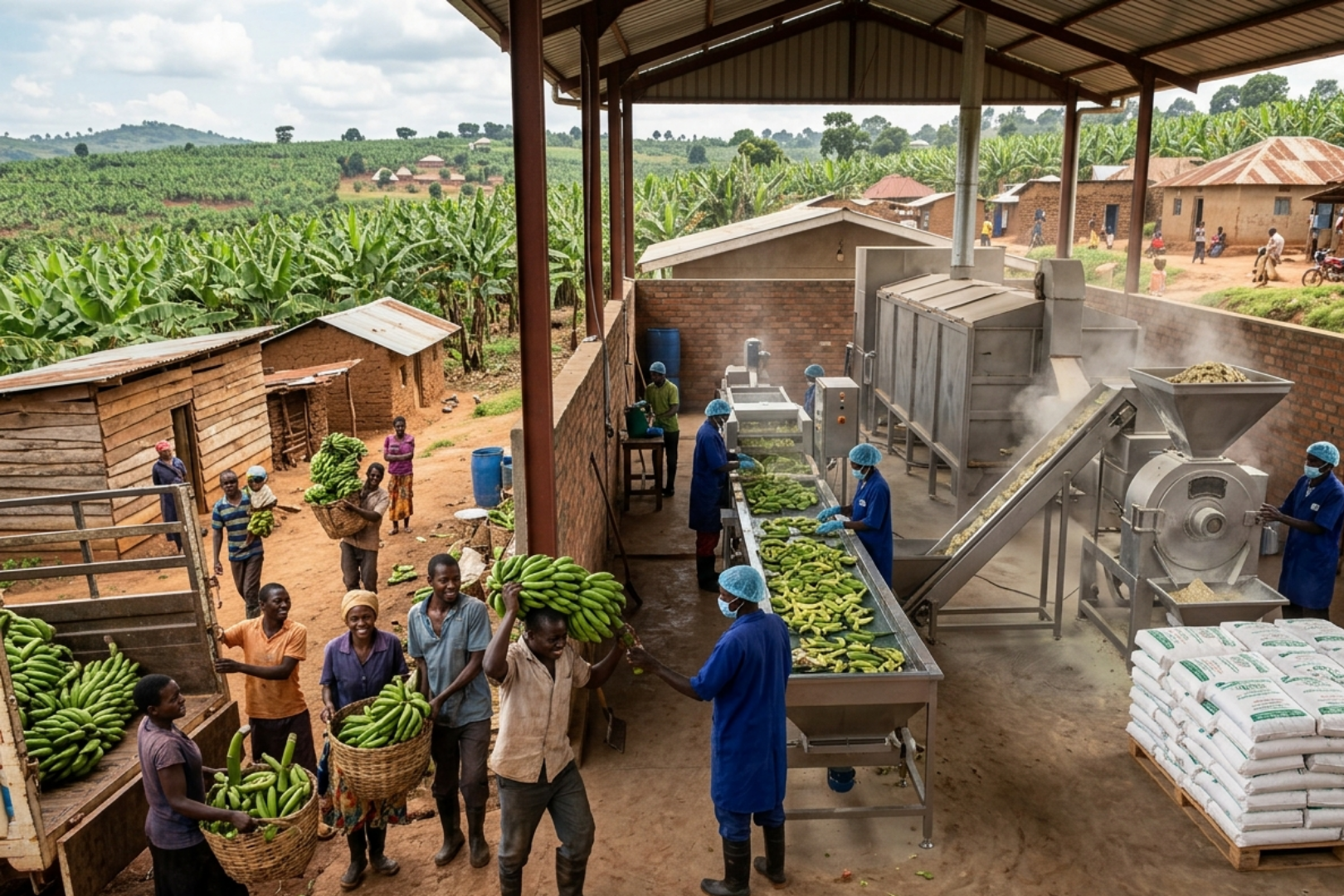
The Presidential Initiative on Banana Industrial Development was established in 2005. A banana processing factory was set up in Bushenyi district under the initiative to produce matooke flour and other matooke products. Now, the situation with processed matooke will benefit the most.
- First, the intermediary personnel, i.e. the middlemen, will be cut off from taking the value entitled to the farmers. When it becomes so, the farmers will earn more and be focused on cultivating on a larger scale.
- Second, there will be investment drawn to this business. Interested investors will come forward to encourage the smallholders to join them in commercial farming. The export potential will rise then. As the product has demand in the market, the ROI will be a key factor in getting more investment.
- Third, banana production will find a mainstream market and priority, apart from mixed-crop farming. Banana occupies, on average, about 30-38% of the cropland. But the production is mixed with other crops, thus becoming dependent. But with improved technical efficiency, output can increase by 58%.
- Fourth, the market for processed matooke flour is rising. As Kagwa said,
“At first, it was a big hustle, but after realizing that the market for my high-value products was the rising middle class, I secured contracts with food chain stores in Kampala.”
The high demand will keep getting bigger, and so will the income. Now, more farmers are encouraged to produce matooke flour after witnessing the success of Kagwa.
Kagwa’s Situation Symbolizes the Whole Market
As we heard the story of Kagwa, his main challenge was to cut off the middlemen. Then, it shifted to finding a market for his product. The local chain shops in Kampala are his primary buyers. As he managed to reduce post-harvest losses and find buyers, the same will apply to the other producers.
Florence Muranga, the director of Banana Industrial Development (PIBID), also has the same view. Muranga said that farmers have a ready market for their surplus bananas, which can be processed into other consumables to avoid undesirable post-harvest losses.
After all, this is a win-win for the producers and the consumers.
Final Thoughts: Uganda’s Processed Matooke
Uganda’s processed matooke production is confined to a zone no more than 150 miles wide. A total of 70% of its production is in the central and southwestern parts of the country. Despite the small area of production, the high-value fruit is catching a lot of attention and has a huge demand.
Thus, investing in Uganda’s processed matooke and matooke-based products like flour is a suitable option to choose without much thinking. Besides, it will create more jobs in the processing industry.
The middle-class Ugandans are mostly dominating the consumer sector, and the demand is on the rise. With all the opportunities ahead, the area, income, and ROI can be greatly improved.
If you are interested in learning about Uganda’s sustainable farming practices and the farmers in Uganda who have embraced them to become successful, you can also read Uganda’s Sustainable Farming Practices.





0 Comments