

Introduction: Foreign Investment Guide to Start a Business in Malawi
“Malawi” is a country with pleasing natural beauty in southeastern Africa. It is a country that is geographically landlocked. It is also known as “the warm heart of Africa” for the hospitality of the people. As a developing country, it welcomes foreign investors in multiple sectors such as agriculture, tourism, mining, and renewable energy. The government is also pushing hard to make the country more business-friendly and attract more foreign investors. There are a lot of opportunities to start a business in Malawi waiting to be discovered.
Now, a question can arise whether a foreigner can start a business in Malawi. The answer is positive. However, a foreign investor must go through some legal and administrative procedures to start a business in Malawi. This article will discuss the challenges, opportunities, and strategies for a foreign investor to successfully start a business in Malawi.
Market Entry Strategy to Start a Business in Malawi
If a foreign investor wants to invest in or start a business in Malawi, they must do so with clear, well-planned strategies. If investors follow these strategies, they can succeed in this area. The strategies are:
1. Market Research: Market research is one of the key factors because, through this, an investor will understand the behavior of a customer by thoroughly analyzing the market, such as demand, competition, and pricing. Incorporating local consultants or agencies can provide valuable insights into specific sectors and regions.
2. Selecting the Right Business Structure: A Foreigner can start a business in Malawi by following the right business structure, such as a sole proprietorship, partnership, or limited liability company.
A Limited Company (Ltd.) is the most recommended business structure in Malawi as it offers limited liability and a clear corporate structure. Besides, this business structure helps the investor to increase or even multiply the capital easily.
3. Register with MITC and Relevant Authorities: A Foreign investor must have to engage with the Malawi Investment and Trade Centre (MITC).
MITC will facilitate the investor with investment permits, business residence permits, and provide aftercare services. Other requirements include:
a. Registering with the Registrar General
b. Obtaining a TPIN from the MRA
c. Registering with VAT (if applicable)
d. Securing sector-specific licenses and permits
4. Collaborating with Local Businesses: Partnering with local entrepreneurs is very useful for investors looking to start a business in Malawi. From this point of view, the foreign investors can understand the culture, social norms, and local constraints in a comprehensive manner. In many sectors, it is preferred to have local ownership.
5. Secure Permits and Visas: Foreign investors need a Business Residence Permit (BRP), which is permitted by the immigration department. A foreigner also requires key employees and work permits for expatriates. Due to the required time for processing, the applications should be submitted early.
6. Leverage Investment Incentives: The Malawi government offers several incentives to attract foreign investors to invest in or start a business in Malawi. These incentives can be helpful for an investor. The criteria for the incentives are:
a. Tax holidays for priority sectors.
b. Duty-free importation of capital equipment.
c. Industrial rebates
d. Access to Export Processing Zone (EPZs) with relaxed trade restrictions.
Market Challenges
All opportunities come with challenges, too. There are some market challenges in starting a business in Malawi as a foreigner. A foreign businessperson might go through these challenges while starting a business in Malawi:
1. Lengthy Paperwork: To start a business in Malawi, a foreigner must obtain a license and renew it annually. To issue this license, a foreigner must go through some steps. This includes the Registrar General’s Department, and getting a Taxpayer Identification Number (TPIN) from the Malawi Revenue Authority (MRA).
Additionally, they might need sector-based licenses based on the type of business. Foreign investors can be easily guided through the Malawi Investment and Trade Centre (MICT) as they provide clear, concise business plans that can help investors become familiar with both the short- and long-term aspects of an investment.
However, there are some bureaucratic delays and administrative procedures that can make the overall process lengthy and slightly difficult for a foreign investor.
2. Poor Infrastructure: In Malawi, only urban areas such as Lilongwe and Blantyre are infrastructurally developed.
Rural areas are also not infrastructurally developed. In addition, rural areas face multiple challenges, such as transportation, electricity, and internet connectivity. These limitations can make it problematic for a foreign investor to start a business in Malawi’s rural areas in the organization, technology, and manufacturing sectors.
3. Foreign Exchange and Risks: Traditionally, Malawi’s currency has faced some backlash. The Malawian Kwacha is not stable, and there can be difficulties with foreign exchange during economic instability.
A foreign investor should take this risk into consideration. Moreover, the investor should come up with solutions to these problems too, as that can unveil new business opportunities. For example, as the Malawian Kwacha is not stable, the investors can come up with a solution with the government to make it stable.
4. Limitations of Labor and Skill Gaps: In Malawi, there are sufficient laborers and affordable housing. However, the main factor is that they are not very skilled in new technology.
These skill issues can be a critical concern because skilled human resources are very crucial for organizing and managing. However, it can also be an opportunity to create an effective and efficient workforce from scratch.
5. Political and Economic Instability: Malawi is successfully able to maintain relative peace. However, they are experiencing some political unrest and governance challenges. The policy change and delayed implementation can affect the Investors. Therefore, the investor should consider this and invest with the possible risks keeping in mind.
Market Opportunities to Invest or Start a Business in Malawi
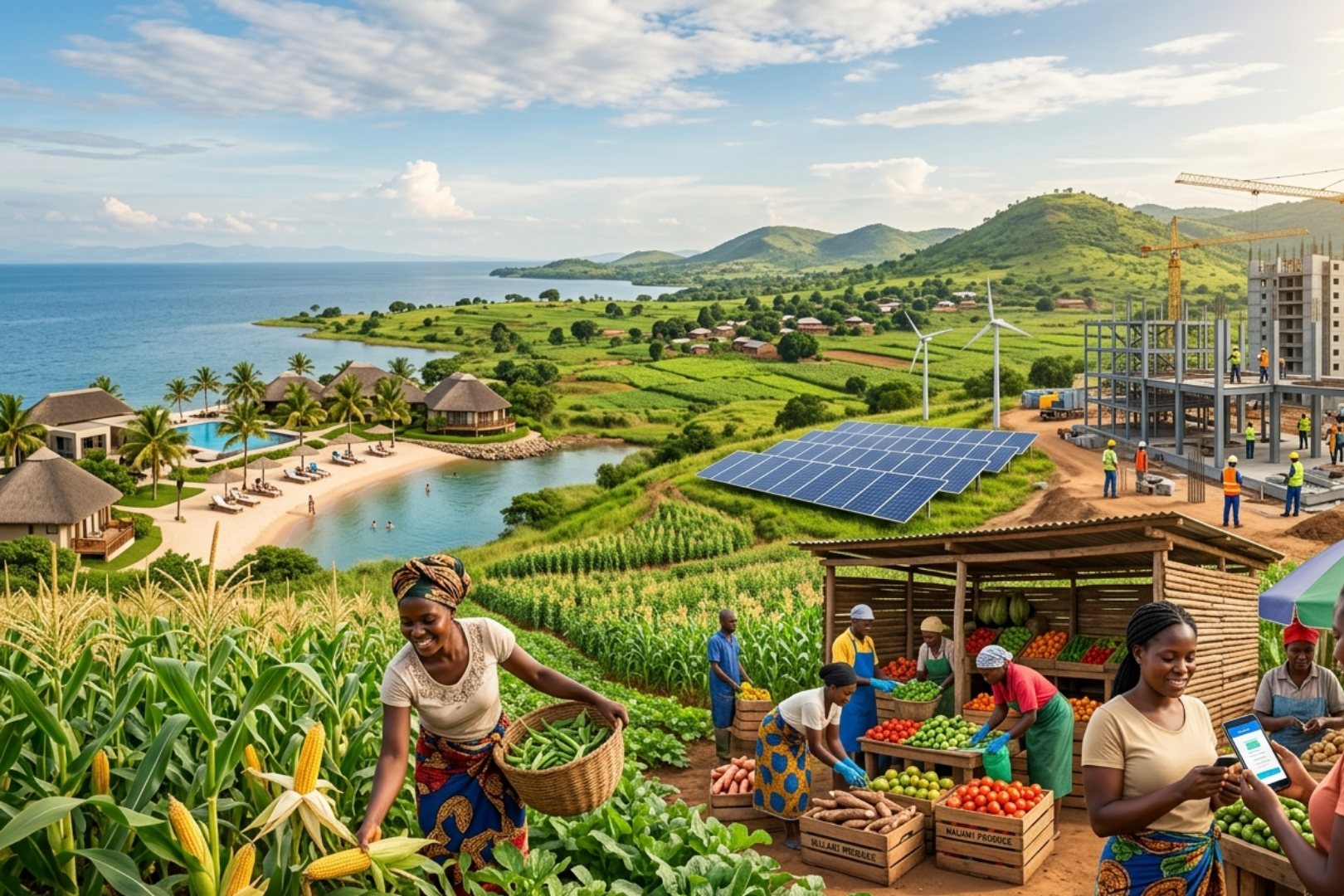
Although there are some constraints, Malawi presents several opportunities for investors. These opportunities can have a positive impact on investors, enabling them to achieve the highest return on their investment. Those opportunities include
1. Agriculture and Agro Processing: Malawi is a country with an economy dependent on agriculture. 30% of the GDP is contributed by the agriculture sector.
Employment is another factor that is dependent on agriculture, and the percentage here is 80%. The major advantages of this area include fertile land and a favorable climate.
Moreover, commercial farming, irrigation projects, agro-processing, and export-based agriculture, such as macadamia nuts, tea, coffee, and tobacco, will take the opportunity to the next level.
2. Renewable Energy: Malawi is facing an energy crisis. Only 10% of the population can access electricity. This creates an opportunity for investors to use this crisis to invest in producing electricity with renewable energy. The government of Malawi is encouraging investors to address the crisis by effectively using solar, hydro, and wind energy.
The foreign companies that have expertise in renewable energies can get an enormous scope due to off-grid energy services and Mini-Grids for rural areas.
3. Tourism and Hospitality: The tourism sector has a series of opportunities in Malawi. It is because of the picturesque beauty and the hospitality that make the country so special.
Furthermore, Lake Malawi is a place known for its beauty and uniqueness of the place. These create an opportunity for an investor to open vast opportunities in the tourism and hospitality sectors.
4. Financial Technologies (FinTech): The banking and mobile money ecosystem sector is expanding in Malawi. However, most of the population of Malawi remains unbanked. There is an opportunity for FinTech startups to provide digital financial services, especially in rural areas.
Mobile baking, microfinance, and digital wallets are gaining popularity among the people of Malawi. They create opportunities for innovation and foreign partnerships to invest or start a business in Malawi.
5. Real Estate and Construction: As Malawi is a developing country, the rapid growth in urbanization is visible. This rapid urbanization and economic growth provide room for the high demand for residential and commercial infrastructure.
Investors can explore opportunities in real estate development, housing projects, malls, and construction services to invest or start a business in Malawi.
Easy Tips for Investors
As a foreign investor, it can be fruitful to start a business in Malawi if one can move strategically. Here are some tips that will assist an investor in considering before entering the Malawian market:
1. Understand the Legal Framework: The investor should keep in mind the following matters before they invest or start a business in Malawi.
a. Investment policies
b. Tax
c. Labor laws
d. Immigration laws
Moreover, it is recommended for the investors to hire a local legal advisor to navigate.
a. The company registration
b. Licensing
c. Regulatory Compliance
The assistance of the Malawi Investment and Trade Centre (MITC) and the Registrar General is a crucial touchpoint for the investor.
2. Secure the Right permit and Registration. Before starting the operation, the investor must ensure all the permits, such as:
a. A Business Residence Permit (BRP) from the Department of Immigration.
b. A Taxpayer Identification Number (TPIN) from the Malawi Revenue Authority (MRA).
c. Relevant sector-based licenses, depending on the type of business.
These legal documents are mandatory and must be renewed as required.
3. Partner with Local Stakeholders: Having a local stakeholder can be helpful to ease the bureaucratic processes and help to understand the business culture, consumer behavior, and market dynamics. A local presence also increases trust and the scope for networking.
4. Be Prepared Infrastructure Limitation: The investor should keep in mind that infrastructures such as electricity, roads, and internet in rural areas may be unreliable. The investor should be prepared for this issue.
If investors want to run their operations in rural areas, they must consider this issue and make plans accordingly.
5. Respect Cultural Norms and Social Etiquettes: The societal norms and regulations vary from society to society. Investors must be patient to build relationships with the locals. It is especially important if the business needs to be sustained in the long run .
A business cannot survive in a country without maintaining and being respectful to the social norms of that particular country. Moreover, understanding local customs, language, and communication style can improve negotiations and community engagements. More engagement can make the business more valuable and reach a great number of customers.
Why Start a Business in Malawi?
Malawi is a country where foreign investment can be utilized properly. The utilization can be done easily and effectively by focusing on the application. If an investor focuses on opportunities, how those opportunities can be beneficial in the long run, and what benefits they can get in the long term, it is worthwhile to invest in this country.
Also, every opportunity comes with both advantages and disadvantages. The advantages in the case of Malawi are the investment-friendly policies, a proper business environment, and untapped sectoral opportunities.
It is not always possible for countries to invest in other countries because of the government regulations and higher expenses. However, in the case of Malawi, it is not the case, as it provides the opportunity to the investors to invest with fewer complications in regulations.
The business environment is also a major factor for a possible investment, and that is also positive in this case. Lastly, there are many opportunities in the agriculture, energy, tourism, etc., sectors. Hence, Malawi is a great choice to start a business or invest in a business.
Final Thoughts: Yes, as a Foreigner, You Can Start a Business in Malawi
At the end, the answer to the question is “Yes,” a foreigner can start a new business in Malawi.
Every opportunity comes with possible risks, and that is normal. It is mostly evident in the case of Malawi because of many factors such as an investment-friendly environment, A proper environment where business can be done easily, and numerous opportunities.
In the long-term perspective, Malawi has a great opportunity as it can not only do great in terms of business but also create job opportunities, develop skills, and ensure the economic development of the country.
Malawi is also placing emphasis on technological invention and modernization that can create a great position in the global market. For this reason, the foreign investors can invest or start a business in Malawi at this time to utilize the opportunity in the proper manner.
If the right approach and mindset are in place, you can start a business in Malawi or maybe invest in another business that can be beneficial for you as a foreign investor.





0 Comments