
Introduction
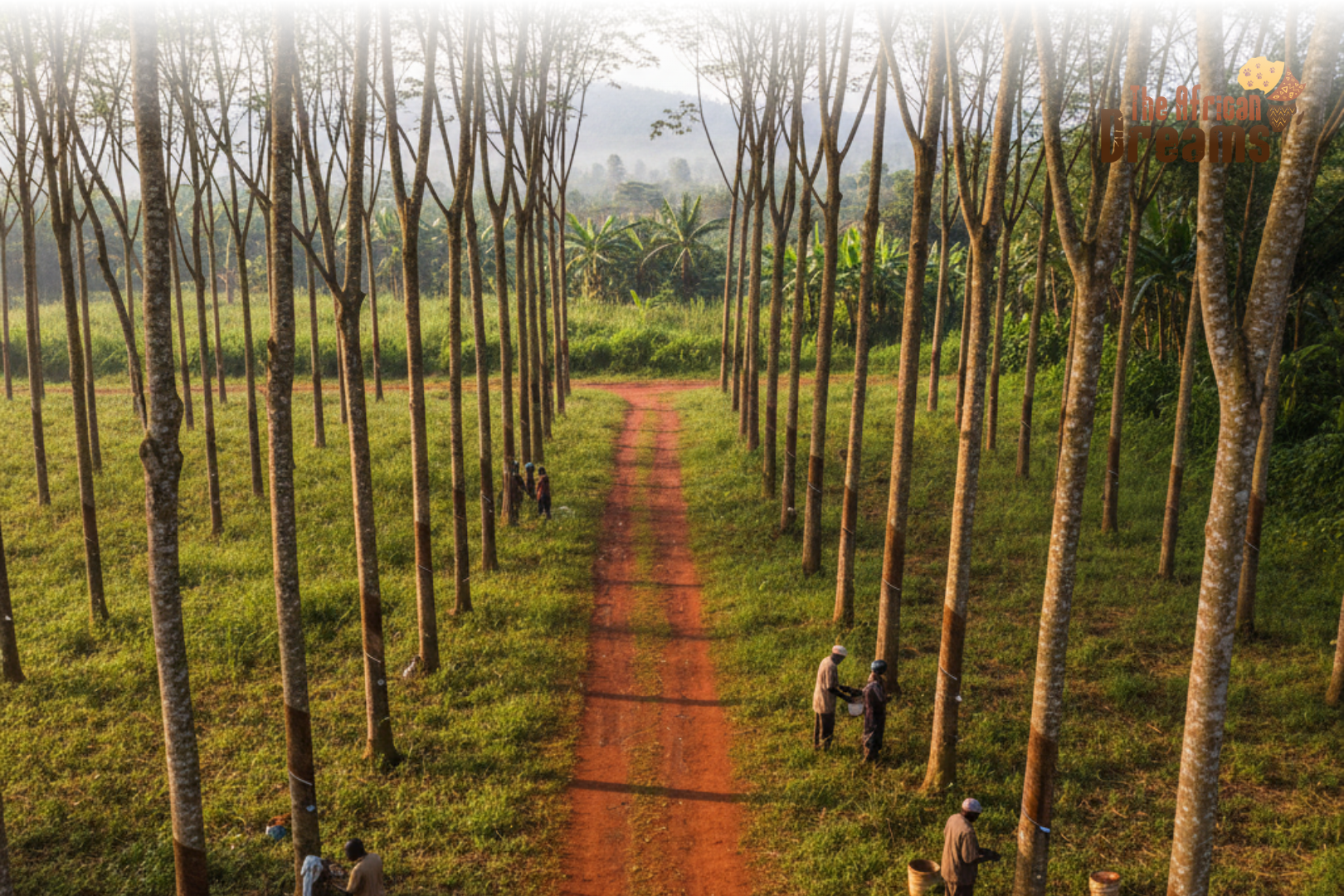
The practice of rubber farming exists throughout the world, but Uganda sees it as a new opportunity. Let’s talk about what’s really happening—far from the headlines, in the quiet fields of Uganda. Here, farmers are starting to plant rubber trees. Not because someone told them to, but because they’re seeing the future.
Rubber isn’t flashy, but it’s everywhere. It’s in the tires that keep trucks moving. It’s in medical gloves. It’s used in shoes, factories, buildings—almost everything that moves or holds pressure uses rubber. The world depends on it. And at the moment, there is a search for new sources of natural rubber by industries around the world.
However, since Uganda has a favorable environment with good soil and tropical climatic conditions, it is ideal for it. Rubber trees grow well here. It takes them a few years to come to bearing age, but once they begin to produce, they supply latex for years continuously. That’s not just a crop—it’s long-term income. Farmers who plant rubber today are planting steady earnings for the next twenty years.
People are starting to notice this opportunity. The government is encouraging rubber farming. There are talks of setting up processing plants. Investors are asking questions. Farmers are getting trained. And slowly, rubber is rising beyond the level of an experiment – it is turning into a prospect.
This is not a dramatic shift we see in the news, nor are there major structural changes. It’s slower. Quieter. But it’s happening. One tree, one farm, one village at a time. When you step back and look at the picture, that is what you see: Uganda is sitting on something valuable. It is not oil or gold this time, but rubber that is the reason behind the conflict. This could mark the start of a new chapter for the country’s economy, as the government moves forward. A greener, steadier one
Article Highlights
Understand how Uganda’s climate and land make it ideal for long-term rubber cultivation.
Learn how rubber trees can offer a stable income for 20+ years and reduce Uganda’s import dependence.
Discover government plans, local success stories, and processing opportunities in Uganda’s rubber sector.
Explore lessons from the Ivory Coast and Ghana that Uganda can adapt for national rubber industry growth.
See how Uganda can become a major rubber supplier for East and Central Africa through smart investments.
Historical Roots
Let’s go back in time—over a hundred years ago. Rubber didn’t start in Uganda. It was introduced here by the British colonial masters. They were in search of areas where they could cultivate rubber so that they could supply it back in Europe. Uganda had the right climate. Therefore, they started planting trees, organizing some farms, and just waited.
However, this was not to be as expected.
The problem was that Uganda was not ready for it. As a result, there were not many roads during that period. Moving rubber from the farm to the city, and then to ships, was expensive and slow. Plus, countries in Asia like Malaysia and Indonesia were already doing better. Their rubber was cheaper. Their systems were more organized. Buyers preferred them.
So, rubber in Uganda didn’t grow the way coffee or tea did. It stayed small. Quiet. Some plantations stopped completely. Others struggled to keep going. But a few farmers didn’t give up. They believed in rubber. They used money from coffee sales to support their rubber trees. These farmers kept planting and learning.
Even though no one talked about it much, rubber farming stayed alive in small corners of the country.
Now, years later, that persistence is starting to matter. The world is once again looking for natural rubber. And Uganda still has what it takes—good land, the right weather, and people who already know how to grow it. What started as a forgotten crop during colonial times is now being seen as a smart investment for the future.
So yes, Uganda’s rubber journey had a slow beginning. But the roots were planted long ago. And now, they’re starting to grow stronger.
Current Landscape
Rubber farming in Uganda isn’t a big industry yet, but it’s no longer hidden. It’s starting to grow. Slowly, but steadily.
Right now, most of the rubber used in Uganda actually comes from outside. The country imports it—mainly from India, China, and the UAE. It’s used in local factories that make plastic products, tires, and gloves. That means Uganda is spending money to buy something it could be growing itself.
But that’s starting to change.
A few years ago, the Ugandan government began encouraging people to plant rubber trees, especially those who own unused land. They saw the potential—not just for farming, but for creating an entire industry around it. Rubber could help reduce imports, create jobs, and even bring in money through exports.
Some farmers have already started. Small plantations are being set up in areas like Buikwe, Masindi, and parts of the central and western regions. Local leaders are guiding them, and agricultural officers are offering advice on how to manage rubber farms properly. These early adopters are showing others that it’s possible—and profitable.
At the same time, discussions are happening about processing rubber right here in Uganda. If the country can produce and process rubber locally, it could support everything from medical supply companies to tire manufacturers. Right now, much of that business goes abroad. But with the right steps, Uganda can keep that value inside the country.
This stage of growth is important. It’s like building the foundation of a house. It might not look big yet, but the structure is forming. Rubber is no longer an abstract concept; it is gradually becoming a reality in Uganda’s fields, policies, and plans.
Global Demand
Rubber isn’t just for farmers. It’s something the world needs every single day. And that need is only getting bigger.
Most of the natural rubber produced today is used for one thing—making tires. Over 70% of all rubber goes into cars, buses, and trucks. The rest is used in many other things: gloves, shoes, belts, hoses, and even parts in airplanes and hospital tools. From homes to industries, rubber plays a quiet but important role.
More people are buying cars. More buildings are being built. Factories are producing more goods. This means that there is an increase in consumption of rubber and not only in the developed countries, but also in the developing countries such as those in Africa, South Asia, and Latin America.
Currently, Asia is the source of most of the world’s rubber. The top producers of this product are Thailand, Indonesia, and Vietnam. However, these countries are experiencing some issues. Land is limited. Farming costs are going up. Climate changes are the reasons that contribute to the poor growth of trees in the current world.
As such, the firms are looking for new areas to expand rubber production.
That’s where Africa comes in. Africa, as a continent, contributes only a small percentage of the global natural rubber, which is below 10%. But that small share has big potential. Ivory Coast is already leading Africa in rubber farming. Now it’s Uganda’s turn.
Uganda has what the world needs: good land, the right weather, and growing interest in farming. Rubber trees grow well here. And global buyers are looking for new partners who can supply rubber the right way—clean, ethical, and steady.
Uganda might be new to the game, but the timing is right. If farmers, investors, and leaders work together, Uganda can become a trusted supplier in the global rubber market. The demand is there.
The question is—will Uganda step in to meet it?
Investment Opportunities
Uganda’s rubber industry may still be young, but the potential it holds for investors is big and real. Let’s break down where the opportunities lie.
1. Long-Term Yield Makes Rubber Low-Risk
Rubber trees take a few years to mature, but once they do, they keep producing latex for 20–25 years. This makes it a great long-term investment—ideal for patient capital.
-
One-time planting, decades of harvest.
-
Latex can be collected regularly, creating a stable yearly income.
-
Less replanting cost compared to seasonal crops.
2. Plenty of Land, Ready to Use
Uganda still has large areas of arable land that remain unused, especially in central, western, and northern regions.
-
The soil and climate are ideal for rubber cultivation.
-
Land prices are still relatively low compared to other parts of Africa.
-
The government is actively encouraging plantation on idle land.
3. Value Addition Through Local Processing
Uganda mostly imports rubber products. That’s a loss in value. But if rubber is processed locally, Uganda can control the entire value chain.
-
Investors can set up processing units to produce smoked rubber sheets or industrial items.
-
Rubber can be used to manufacture gloves, hoses, gaskets, tires, etc.
-
Processed rubber products can be exported to regional markets.
4. Regional Market Is Wide Open
Uganda is surrounded by countries that already import rubber-based products.
-
Kenya, DRC, Rwanda, and South Sudan are potential buyers.
-
With good infrastructure, Uganda can serve the East and Central African demand.
-
Local production reduces cost and delivery time.
5. Government Support & Policy Direction
The Ugandan government sees rubber as part of its industrial future.
-
Tax incentives are available for agricultural processing ventures.
-
Rubber is included in national agricultural investment plans.
-
Possible inclusion in future public-private partnership schemes.
Challenges and Solutions:
Rubber production has the potential in Uganda, but there are some factors that hinder the process. These are not barriers but issues that need to be addressed in the right manner. I will explain them as follows:
1. Poor Roads Make Transport Difficult
Some of the rubber growing regions of Uganda still experience poor road networks. Several of those roads become muddy whenever there is rain. That’s a real problem for a crop like rubber, which needs to be processed as soon as possible after it has been harvested.
The problem: Transport is slow and expensive. At times, latex deteriorates before getting to the factory.
The solution: The government can repair and build better rural roads so that people in rural areas do not face any problem while travelling to their workplaces or any other place they have to go. There is a need for companies to open up collection points that will be nearer to farms.
Why it matters: When transport is enhanced, farmers can sell rubber, and more of it within a shorter time, hence, they will get more from it.
2. Not Enough Places to Process Rubber
The population of rubber factories in Uganda is very limited. That means raw latex most of the time remains unutilized, or it is sold at the wrong time when it has not reached the value addition stage.
The problem: When processing time is not fast, quality reduces and with it the profits.
The solution: Investors and cooperatives could establish small processing centres within the vicinity of farming areas.
Why it matters: This is because most of the value generated from local processing of the products is retained within Uganda. Also, it generates employment opportunities and confidence in the product among the customers.
3. Global Markets Have High Standards
To sell rubber internationally, you need to meet strict rules about quality and cleanliness. But many farmers haven’t been taught how to meet those standards yet.
The problem: Farmers may grow rubber that doesn’t pass quality tests abroad.
The solution: Offer basic training, grading tools, and simple rubber testing stations at the district level.
Why it matters: When rubber meets export standards, Uganda can sell to bigger, better-paying markets.
4. The Environment Needs Protection
Rubber farming can go wrong if it’s done by clearing forests or harming the soil. That’s bad for nature and bad for farming in the long run.
The problem: Deforestation and loss of biodiversity if rubber is planted carelessly.
The solution: Use land that’s already cleared. Encourage rubber to be grown with other trees and crops (agroforestry).
Why it matters: Responsible farming protects the land—and builds Uganda’s image as a sustainable producer.
Success Stories: Learning from the Region
Whenever a country starts building a new industry, it helps to look around—see who’s already doing it, what worked, and what didn’t. Uganda may just be starting its rubber journey, but a few other African countries are already much further along. Their stories are full of lessons Uganda can learn from.
Ivory Coast: Small Farmers, Big Results
Ivory Coast didn’t begin as a rubber powerhouse. But over the years, it became the top rubber-producing country in Africa. That didn’t happen by luck. It happened because they invested in people.
-
Small farmers were trained on how to plant and care for rubber trees.
-
The government supported farmer groups and made it easier for them to sell their rubber.
-
Local companies built factories that could process the rubber before sending it abroad.
The impact? Even farmers with just a few acres of land started earning a regular income. Rubber became a dependable source of money in villages that once had little. It helped families send children to school, pay medical bills, and improve their lives.
Ghana: Starting Over with a Clear Plan
Ghana’s rubber story started slowly. For a long time, people didn’t see much future in it. But that changed when both local businesses and foreign investors stepped in with a clear plan.
-
Rubber factories were built inside the country.
-
Farmers were offered better prices and fair contracts.
-
Training was provided to help growers meet export standards.
This didn’t just help the farmers—it helped the whole economy. Ghana now earns more from processed rubber products, not just raw latex. That’s value-added income—and it stays in the country.
Uganda: The Story of One Farmer Who Didn’t Wait
In Uganda, the rubber story is still young. But there’s already one story that proves what’s possible. Back in 2001, a man named Robert Giffen Kamulidwa did something bold.
He leased over 400 acres of land in Masindi. Instead of planting the usual crops, he planted rubber trees. A lot of people didn’t believe in him. They said it was risky. But he didn’t stop.
He even built a small rubber processing facility—something no one else was doing. He processed the latex into smoked rubber sheets, which were then sold for export.
Robert didn’t have big backers. He didn’t have a global company behind him. He used his own money. He believed rubber could work in Uganda—and he proved it could.
These stories show something important: Uganda doesn’t have to guess or start from zero. Other African countries have already walked the path. The models exist. The tools exist. Now, Uganda just needs to shape these ideas in a way that fits its people, its land, and its future.
Future Outlook
Uganda’s rubber story is still young. But what is on the horizon is what counts. This is not about the planting of more trees, for example. It is about creating an ideal system with its base on the farmers, generating income, and resulting in something sustainable.
Rubber Farming Is Set to Expand
More farmers are beginning to understand the value of rubber. They see it as a long-term crop that doesn’t just give one harvest—but many, for over 20 years. That’s a steady income. And as more people hear about success stories, more land is being prepared for planting.
- In districts like Buikwe and Masindi, small rubber plantations are already growing.
- Community leaders are encouraging others to try rubber alongside their food crops.
- The government is also spreading awareness through agriculture offices and training programs.
If this trend continues, Uganda’s total rubber production could multiply in the next decade.
Processing Means More Profit
Planting rubber is the initial step in the whole process. It is therefore important to note that real money is made after the harvest or in the processing stage. It is more valuable to convert latex into such things as rubber sheets, gloves, car parts, and so on than just selling the raw latex.
- This means that if Uganda establishes more processing centers, it can reduce its importation of goods and also offer employment to its citizens.
- This is because factories that are located close to farms have an added advantage of saving on transport costs and also ensure that the latex is not degraded.
- Local industries ranging from health care to construction industries, among others, could begin to use more of the locally produced rubber.
This isn’t a far-fetched dream. Yes, it can be very possible and also quite profitable with intelligent investment.
Uganda Can Become a Regional Supplier
Neighboring countries like Kenya, Rwanda, and South Sudan import rubber products every year. That demand is growing, and Uganda is in a perfect place to serve them.
Uganda already has cross-border trade networks.
With better quality control, rubber sheets and goods could be exported by road, not just shipped overseas.
East Africa could see Uganda as its go-to source for natural rubber.
This is a regional opportunity Uganda should not miss.
A Greener, Stronger Economy
What makes rubber different from other industries is its long-term nature. Once a rubber tree starts producing, it doesn’t need to be cut down. It continues to give latex every few days for decades. That’s stable, renewable income.
-
Rubber trees also help control erosion and keep soil healthy.
-
If grown responsibly, they can be part of Uganda’s climate resilience strategy.
-
With agroforestry, rubber can grow alongside other trees and protect biodiversity.
In short, rubber isn’t just good business—it can also be good for the environment.
If Uganda pays attention to these aspects, the rubber industry can move from potential to prosperity for the farmers, the enterprise, and the nation.
Uganda has the climate, the land, and the people of Uganda. However, with the right choices on its side, it can also become a leader in rubber. The seeds are already planted. The next step is the process of developing the existing ideas into something more complex.
Final Words
Uganda’s rubber industry is no longer just an idea—it’s a growing reality. The pieces are coming together: fertile land, rising global demand, interested farmers, and early investment. But for this potential to turn into real progress, the country must act now—before the window of opportunity starts to close.
Rubber is different from many crops. It doesn’t just bring one harvest or a quick win. It brings stability. It provides income for decades. It creates jobs—not only in farming but also in transport, processing, and manufacturing. And it opens doors to export markets Uganda hasn’t fully entered yet.
The examples are already there. Ivory Coast and Ghana have shown what’s possible with the right mix of training, support, and infrastructure. Uganda has started that journey—but now is the time to speed up. Investors need to see clear signals. Farmers need support in the early years. And local businesses need to know that rubber can be a reliable material they can build with and sell.
The good news? Uganda doesn’t have to invent the path—it just has to follow and adapt it. There’s enough knowledge out there, and enough success stories to learn from.
If rubber is grown wisely, processed locally, and exported smartly, it could become one of Uganda’s most important industries. Not just for today—but for many years to come.
The roots are already in the ground. It’s time to help them grow.
Frequently Asked Questions (FAQs)
1. Is rubber farming profitable in Uganda?
Yes, rubber farming in Uganda can be profitable, especially in the long term. Once a rubber tree matures (around 6–7 years), it produces latex for more than 20 years. This means farmers get regular income for decades from the same trees, making it a smart investment if done with proper planning.
2. How long does it take for rubber trees to start producing latex?
Rubber trees usually take 5 to 7 years to start producing latex. During this time, many farmers intercrop with food crops to earn income while they wait. After maturity, rubber trees can be tapped every few days for latex.
3. What are the main challenges rubber farmers face in Uganda?
The biggest challenges include poor rural roads, lack of local processing facilities, long waiting times before returns, and difficulty meeting export quality standards. However, most of these problems can be solved with investment, training, and better infrastructure.
0 Comments