
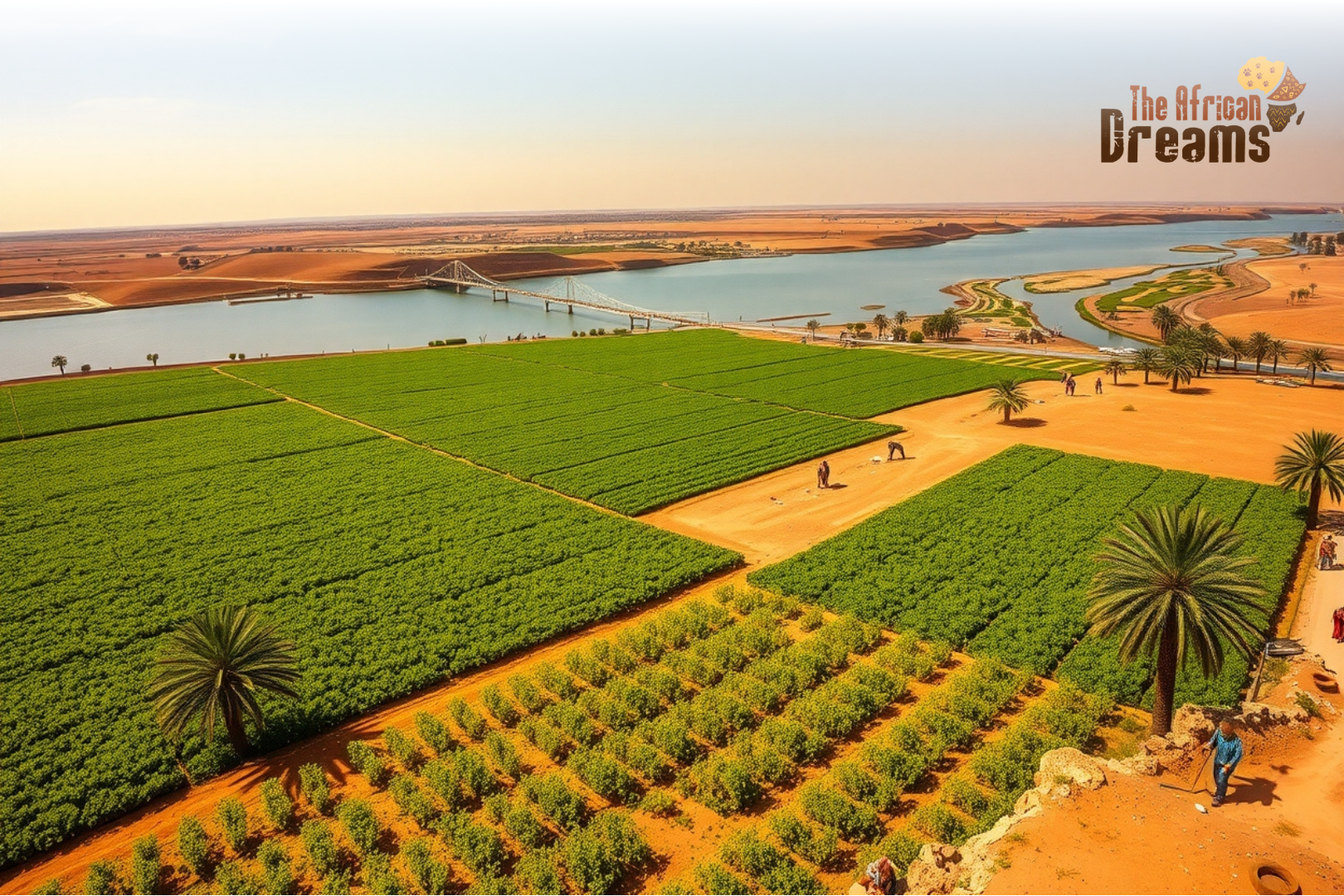
From the beginning of civilization, agriculture has always been an important part of society. Even today, a strong, efficient agricultural system is important. It supports to build an economically stable country. Agriculture ensures a nation’s food security and beyond-border trade. Egypt’s agricultural sector is no different. With a long and rich history of farming along the banks of the Nile, Egypt’s agricultural sector has the history of legacy of growth.
Egypt’s agricultural sector has been considered one of the earliest centers of agricultural development. But how do we see today’s Egypt in terms of agricultural aspects? How does it help maintain the lives of 118 million people? In this article, we will discuss Egypt’s agricultural sector, focusing on its historical origins, current role in the economy, challenges, and technologies and innovations used here.
Agriculture in Egypt: A Historical and Geographical Context
For over 5,000 years, the Egyptians have been engaged in agricultural activities.
History tells that early Egyptians cultivated wheat, barley, and flax. It was possible due to the geographical location- The Nile River. The Nile River has proved to bring rich soil to the land. This has been a great natural aid for Egyptians. It made Egypt a leading agricultural society in ancient times.
Currently, about 3.6 million hectares (roughly 8.6 million acres) are cultivated in Egypt, which covers only about 3% of the country’s mainland. However, the construction of the Aswan High Dam in 1970 became a barrier for the natural flow of nutrient-rich silt. But it helped control flooding and provided steady irrigation.
The Role of Agriculture in Egypt’s Economy
The role of agricultural work has been decreasing over time, but it holds great importance.
According to the World Bank, agriculture contributes around 11.5% to Egypt’s GDP. It employs about 24% of the labor force, mostly in rural areas. These figures demonstrate that cultivation is still a key source of earning for millions.
Egypt also marked her as a significant exporter of agricultural products. For instance, Egypt was the world’s largest exporter of oranges in 2023. Other major exports include potatoes, onions, strawberries, and rice. Through the exchange of foreign currencies, these exports have been a major contributor to the nation’s trade balance.
Unlike Europe and Turkey, Egypt has not stepped into the processed food export, which means there is still potential growth and opportunity in agro-processing industries.
Water Scarcity: The Biggest Challenge
Egypt’s agriculture depends almost entirely on the Nile River, which supplies over 90% of the country’s freshwater. The 1959 deal with Sudan assigns 55.5 billion cubic meters of water yearly to Egypt. But this is insufficient given a growing population and increasing water demand.
The Grand Ethiopian Renaissance Dam (GERD) upstream’s building raises questions about future water supplies in Egypt, so the matter has grown even more critical.
Egypt’s traditional irrigation still relies on costly flooding techniques. Ineffective irrigation causes Egypt to lose up to 40% of its water supply. Modern irrigation techniques, such as drip and spray irrigation, have been promoted by the government, particularly for projects involving the reclamation of deserts. But a lot of small farmers can’t afford these devices or don’t know how to use them.
Main Crops and Farming Patterns
Egypt grows a wide range of crops throughout the year due to its mild winters and hot summers. The main crops include wheat, rice, maize, veggies, and cotton. Wheat is considered a strategic crop for Egypt, as the country is the largest importer of wheat in that region.
Domestic production meets about 50-55% of the demand, as reported by The Economist.
In the Delta region, mainly, rice is cultivated. But water shortage makes the rice a vulnerable crop. Since cultivating rice requires more water, the Egyptian Government has restricted its cultivation.
Besides, the Egyptian farmer utilizes the scorching heat of the summer by cultivating maize and corn, meeting the needs of both domestic and foreign export. In addition to these, Egypt is self-sufficient in producing green vegetables and fruits, including tomatoes, onions, cucumbers, grapes, and citrus fruits, which are widely grown and exported. Apart from this, the white gold or cotton has seen a decline in importance.
In the past, Egyptian cotton was famous worldwide for its quality. However, global competition, lack of modernization, and changing market demands have reduced its role in the economy.
Government Policies and Land Reclamation
The Egyptian government has long sought to reclaim desert areas in order to increase the quantity of land under cultivation.
The Toshka Project in southern Egypt is among the most ambitious. Using water drawn from Lake Nasser, this proposal seeks to turn more than 500,000 acres of desert into farmland. Despite considerable advancements, the project has encountered numerous obstacles, including exorbitant expenses, technical challenges, and environmental concerns.
The government has also prioritized helping small farmers in recent years. They are providing a small amount of risk-free loans, training on modern equipment, and subsidies. The goal of initiatives like “1.5 Million Feddan” is to encourage youth to pursue farming and lessen the strain on the Nile Delta. The word feddan means a unit of area commonly used in Egypt and some other parts of the Middle East. Nonetheless, a lot of farmers gripe about price volatility, market accessibility issues, and bureaucracy.
Climate Change and Environmental Challenges
Climate change has also impacted Egyptian agriculture. The rise in temperatures and irregular rainfall threatens food production. Rising sea levels also add to this. The Nile Delta is particularly at risk due to this. The rising sea levels may flood large parts of it. The impact is huge; thousands of families will be displaced, and farmland will be destroyed.
To address these challenges, Egypt is exploring climate-smart agriculture. It includes.
- Using drought-resistant crops
- Improved water management system
- Proper soil conservation
- Reforestation and
- Carbon capture programs
All these require strong government support, along with international funding and awareness among people.
Role of Technology and Innovation
To modernize the agro sector, Egypt has adopted many technologies. For example, smart irrigation systems using IoT and AI, drone-based field monitoring, and large-scale climate-controlled greenhouses. It uses 80% less water and boosts yields.
Due to the adverse and harsh geographical location, Egypt has valued the concept of genetic engineering. The Agriculture Research Center (ARC) established the National Agricultural Genetic Engineering Lab (NAGEL) in the 1990s to create crops that could withstand drought, salt, and pests.
Ajeeb-YG, a Bt (GMO) maize that is resistant to stem borers, was approved by Egypt in 2008. It is grown in about ten governorates. However, due to the lack of a biosafety law, its use was discontinued in 2012.
Genetic engineering and a patented microbial seed-coating chemical were used in a 2018 National Research Center study to modify wheat seeds, increasing yields by up to 68%, particularly in Sinai and Beheira. However, until GMO legislation is passed, commercial release is once more prohibited.
Egypt is focused on agriculture programs at the University. It has 22 public Universities with Agricultural subjects. They have a partnership with top-notch institutions like Cornell and UC Davis. So, this is also focused on their strong academic foundation in agricultural innovation.
Final Words
For decades, Egypt’s agricultural sector has been important for historical outcomes and economic growth. It is a supportive tool for the country’s employment and livelihoods. Despite the Nile, Egypt’s lifeblood, its child, the country faces droughts as its flow has already decreased. This is very challenging for the country, as it needs more water resources.
However, Egypt is adapting to its challenging climate. The long and evolving history of Egypt’s agricultural sector offers testament to optimism. In addition, technology promotes improvement in the sector. Farmers are using new farming techniques.
To summarize, proper strategy, investment, technological advancement, and management will be beneficial for Egypt’s agricultural sector. All these initiatives will improve the agricultural system and create a modern farming environment. They will also uphold the rich history of Egypt’s agricultural sector and ensure growth and sustainability.
0 Comments