
Introduction
Agriculture in Eritrea is a pillar of the economy, sustaining the livelihoods of most of the country’s population, particularly rural residents. Agriculture in Eritrea is mainly subsistence agriculture, where farmers plant crops for domestic consumption purposes only, with the surplus exported. Agriculture, despite the hostile climate and political seclusion of the country, still has the potential to ensure food security, employment, and national growth.
This blog discusses the overall reach of Eritrean agriculture with a specific focus on vegetable farming from the history of agriculture in the country, climate, and geographical advantage, crop variety, issues, and prospective opportunities.
Article Highlights
70–80% of Eritreans are farmers. Growth in vegetable farming is on the rise due to market demand and nutritional value.
Tomatoes, onions, and leafy greens are the most common crops.
Water shortage, pests, climate change, and inadequate infrastructure are the key challenges.
Government and foreign donors are focusing on irrigation and agro-processing to raise productivity.
Historical Background of Agriculture in Eritrea
Before independence in 1993, the agricultural sector in Eritrea was marginalized under Ethiopian rule. Following independence, agriculture was given priority by the government.
Programs like the National Food Security Strategy (NFSS) were aimed at food self-sufficiency, land use sustainability, and enhancing support to smallholder farmers. Other development partners like the Food and Agriculture Organization (FAO), UNDP, and the World Bank have also provided technical assistance and financing in the past.
Agriculture is practiced by about 70-80% of the population of Eritrea. It accounts for about 20% of the GDP of the country. Most of the activity takes place on smallholder farms with land sizes varying from an average size of about 0.5 to 2 hectares per household.
The small farmers make extensive use of traditional techniques and equipment, and their output is typically limited by erratic rainfall and poor access to other modern agricultural inputs.
Agricultural Practices
Traditional Farming Methods- Most of the farmers in Eritrea still employ oxen-plows and hand tools. Mechanization has been low due to financial constraints and poor infrastructure. Nonetheless, farmers are embracing composting, crop rotation, and other organic farming practices to ensure soil fertility.
Although subsistence farming is the dominant trend, commercial farming is also becoming more the norm. Government incentives now prompt individuals to grow edible crops like tomatoes, onions, and peppers, particularly around peri-urban regions.
Crop Diversity-
- Cereals: Sorghum, barley, teff, and millet
- Legumes: Lentils, chickpeas, and cowpeas
- Vegetables: Tomatoes, onions, potatoes, spinach, cabbage, carrots, peppers
- Fruits: Citrus, bananas, guava, and papayas
Vegetable Farming in Eritrea: Principal Crops
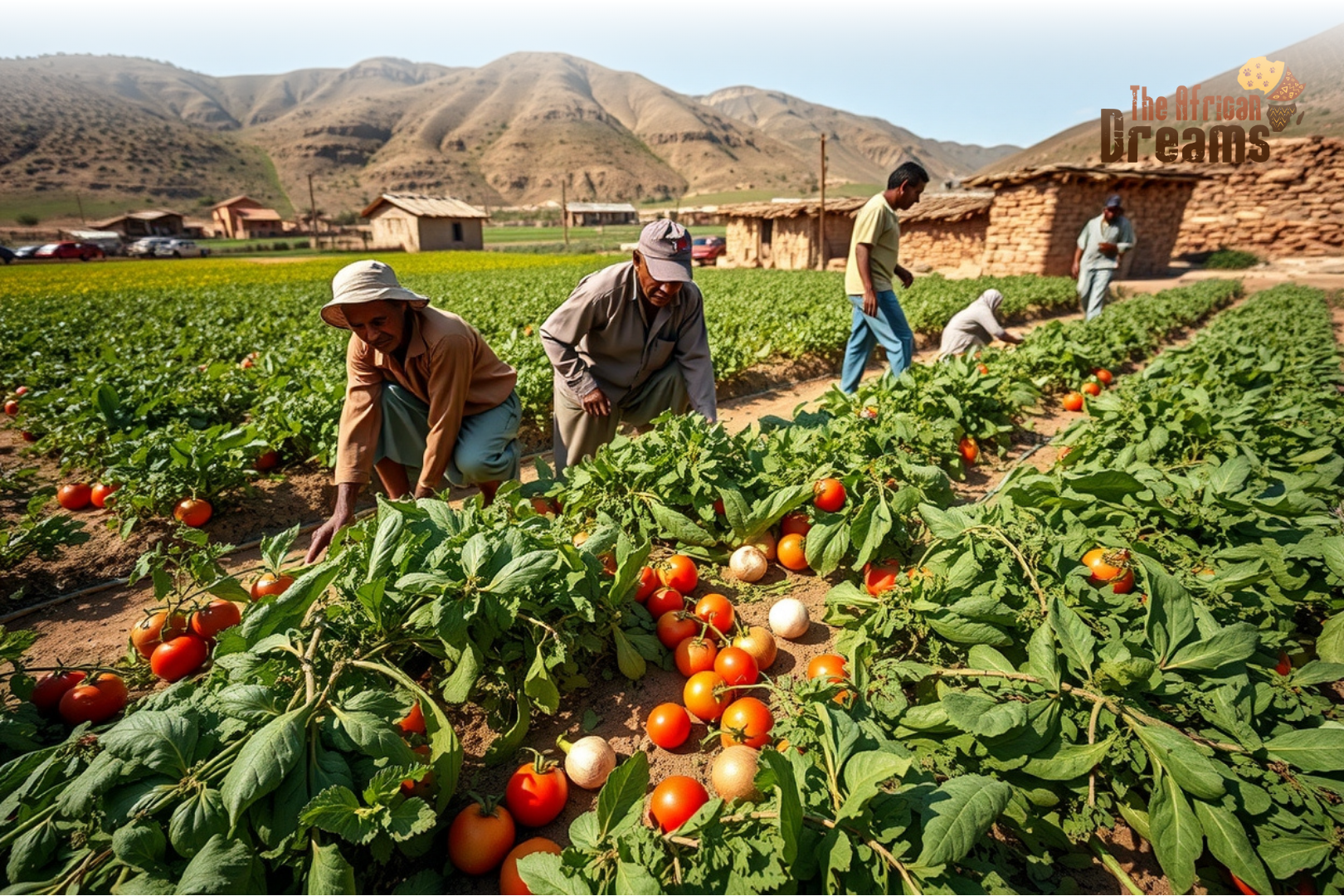
Tomatoes- Tomatoes are a signature crop in Eritrean vegetable farming. Produced on large farm scales in the central and southern highlands, tomatoes are sold locally and exported to Ethiopia and Sudan.
a. Economic Significance: Tomato production complements family incomes via direct markets as well as secondary industries such as the manufacture of tomato paste.
b. Challenges: Pest Problems: Pests: Whiteflies, fruit borers, and aphids; Disease: Tomato blight and bacterial wilt.
Onions- Onions are grown throughout the year under rain-fed and irrigated conditions. They are grown in areas like Dekemhare, Mendefera, and Keren.
a. Varieties: White onions and red onions.
b. Challenges: Poor seed quality, post-harvest loss, and fungal diseases.
Potatoes- Potatoes are among the major sources of cash income and calories for the highland people. Its production is on the rise due to its demand and suitability in the market.
a. Challenges: Late blight, a fungal disease, and poor storage infrastructure.
Leafy Greens (Spinach, Cabbage, Kale)- Leafy greens are nutritious in vitamins and iron and are a major component of the diet in Eritrea. They are predominantly cultivated in small-scale farms and backyard plots.
a. Significance: Used in stews, salads, and staples like alicha and hamli.
b. Challenges: Soil fertility maintenance and control of pests, particularly caterpillars and snails.
Peppers- Onions and chilies are widely employed in nearly all Eritrean cooking and are a food staple. Chilies are extensively grown in lowlands and highlands.
Beets and Carrots- Less common but also under cultivation in irrigated land. These are becoming more popular with health-conscious consumers.
Livelihoods and Gender Roles in Vegetable Farming
Women play a central role in Eritrean farming, particularly in vegetable production and sales. Women manage home gardens, seed banks, and sell the produce at local markets in the majority of places.
Women farmer empowerment through microcredit and farm training interventions is increasingly being seen as a way to enhance household food security.
Major Eritrean Agriculture Challenges
- Climate Change and Environmental Stress: Eritrea is most vulnerable to climate shocks. Flash floods, temperature variations, and drought severely affect yield and farmer resilience.
- Water Scarcity: Availability of water is the most important challenge. Ineffective irrigation, limited groundwater, and extended dry seasons constrain vegetable production growth.
- Constrained Input Availability: Most farmers lack access to good-quality seeds, fertilizers, and pesticides. The government purchases most of the farm inputs from imports, and availability is irregular, especially in outlying areas.
- Pests and Diseases: Insect and disease attack on crops lead to heavy losses. Lack of diagnostic laboratories and trained extension agents worsens the situation.
- Market Access and Infrastructure: Poor infrastructure on roads inhibits the transportation of fresh vegetables to urban markets. This tends to lead to post-harvest loss and lower prices at markets.
- Inadequate Financing for Agriculture: Rural farmers have poor access to insurance schemes or credit. Banks are reluctant to offer agricultural credit due to high risks.
National Policy and Governmental Actions
The Eritrean government has tried to enhance agricultural improvement through the following methods:
- National Food Security Strategy: Focus on water harvesting, improved seeds, and self-production.
- Irrigation Development Projects: Micro-dam and canal water diversion construction.
- Soil and Water Conservation Programs: Terracing and check-dam use for anti-erosion.
- Extension Services: Chains of small but increasing agricultural officers and local training schemes.
Role of International Organizations
Several international organizations support Eritrean agriculture:
- FAO: Enables technical training, improvement of seed quality, and soil mapping.
- IFAD (International Fund for Agricultural Development): Financing rural livelihood projects.
- World Bank and African Development Bank: Invests in roads and irrigation.
- UNDP: Engaged in resilience building and climate-resilient agriculture.
Success Stories of Eritrean Vegetable Farmers
Although the agricultural sector in Eritrea is faced with a multitude of obstacles, several inspirational success stories are testaments to the mettle of Eritrean farmers. Such success stories confirm the wider impact of targeted development programs, irrigation facilities, and rural-based vegetable growing programs.
Hagaz Farmers’ Cooperative Transformation- In Anseba region’s Hagaz town, smallholder farmer cooperatives came together to establish a vegetable-growing cooperative. Their cultivation initially was wholly rain-dependent, and this limited their production to a few months in a year. With support from the Ministry of Agriculture and technical guidance from the FAO, the cooperative received training in water harvesting, composting, and drip irrigation.
Farmers are able to cultivate vegetables such as tomatoes, kale, and carrots year-round. Farm products increased by over 40% in a period of two years.
The co-op members now sell fresh fruits and vegetables to surrounding markets and schools, and even export excess to Sudan. Mr. Bereket Ghebreselassie, one of its founders, said
“Economically, we used to rely solely on rain, and our harvests were never sufficient. Today, our children go to school, and we even have the capacity to save. Vegetable farming has transformed our lives.”
Future Opportunities and Prospects
- Irrigation Development: Drip and solar irrigation expansion can change vegetable farming. The Gash-Barka and Debub regions are highly promising regions.
- Agro-Processing: Investment in tomato paste factories, vegetable dryers, and cold storage warehouses will reduce post-harvest loss and enhance export potential.
- Organic Farming: Organic farming is gaining momentum with farmers who want to reduce chemical input costs and address specialty niche markets overseas. Certification and market development are the main concerns.
- Youth Involvement: As Eritrea is a fairly new nation, there is a wonderful chance to bring the youth in agriculture into the fold with the help of tech-based farming, agri-business training, and start-up incubators.
- Use of Technology: Accessibility of cell-phone-based platforms for weather, crop guidance, and market prices will play a major role in increasing productivity.
Final Words
Eritrea’s vegetable sector and, by association, its agriculture play a vital role in stabilizing as well as providing a window of opportunity for the country to grow. Given such extreme adversity—ranging from water scarcity and climate vulnerability to the lack of infrastructure—Eritrea has a firm agricultural base. With concerted action by government, civil society, and the global community, Eritrea is not only able to feed its people but also export value-added vegetables to its neighboring countries.
Vegetable farming, in either scenario, would be helped with authentic investment in irrigation, infrastructure, markets, and green technology. Even when Eritrea stabilizes and expands, agriculture will remain at the forefront of its economic growth.
Frequently Asked Questions (FAQs)
1: What is Eritrea doing for post-harvest losses of vegetables in its production?
Post-harvest loss is also a serious problem due to a lack of refrigeration facilities, inadequate transport, and storage facilities. As a measure to reduce this, the government and NGOs have encouraged low-cost storage facilities, post-harvest handling training, and agro-processing factories like tomato paste factories.
2: What sort of government support do Eritrean farmers receive?
Very limited but directed support is rendered by the government to farmers, like subsidized seeds, technical training, irrigation facilities, and, in some cases, grants or land plots to returning diaspora or youngsters willing to pursue farming.
3: Is there an agricultural college or school of training within Eritrea?
In fact, Eritrea does have agricultural training institutions like the Hamelmalo Agricultural College (HAC) near Keren, which offers degree and diploma programs in agronomy, horticulture, and other allied courses. Extension services also extend step by step to the rural belt to provide on-field services to farmers.
4: What are the most promising areas for vegetable farming in Eritrea?
Debub (Mendefera, Dekemhare), Anseba (Hagaz, Keren), and Gash-Barka (Barentu, Tesseney) are the most appropriate locations due to their relatively favorable climate, rich soils, and emerging irrigation facilities.
5: What action is Eritrea taking to combat climate change in agriculture?
Eritrea is building climate-resilient agriculture through water harvesting, solar-powered irrigation, drought-resistant seeds, and organic composting. National sensitization and donor programs are building farmer resilience.
6: Are Eritrean vegetables capable of entering export markets?
Yes, particularly with the immediate neighbors Sudan, Ethiopia, and the Gulf States. Export is, however, limited by infrastructural and regulatory constraints. Investment in cold chains and certification procedures would make this sector grow extensively.
7: What is the contribution of the Eritrean diaspora to agriculture?
The Eritrean diaspora plays a significant role in investing in agriculture, remittances, funding irrigation schemes, and establishing agro-processing plants. Others have returned to establish farms and agribusinesses, and are also returning skills and capital.
8: Is it possible for Eritrean agriculture to be self-sustaining?
Through ongoing investment in irrigation, infrastructure, capacity building, and sustainable agriculture practices, Eritrea can be food-independent, particularly in vegetables and certain cereals. Subject to political stability, climatic conditions, and the continued interest of development partners.
9: Is organic farming practiced in Eritrea?
Yes, though in its nascent stage, organic farming is making inroads due to the minimal use of chemicals in conventional farming methods. Organic leafy greens and herbs are gaining more interest for export to value-added foreign markets.
10: How should the youth be encouraged to pursue agriculture?
Employment schemes in agribusiness, access to land and finance, and use of digital technologies like mobile apps to monitor crops, predict weather, and access markets can enhance participation by youth.
0 Comments