
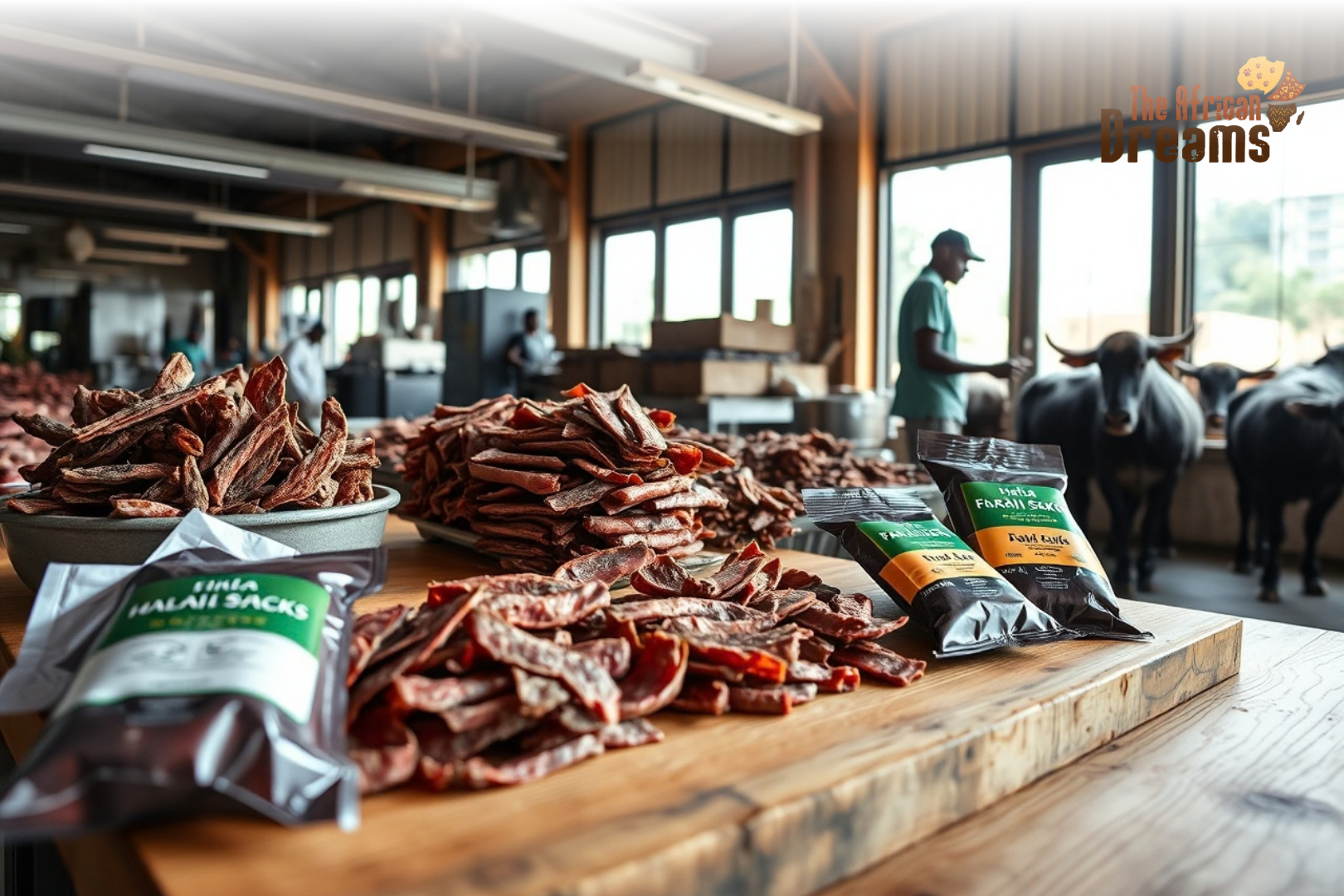
Introduction: African Halal Jerky
The African halal jerky market sits at an interesting intersection of three established food categories: halal meat, processed meat, and convenient packaged snacks. For businesses examining the halal beef jerky market, Africa offers several conditions worth investigating, including substantial Muslim consumer populations, established cattle sectors, traditional dried-meat products, and expanding urban food markets. However, the opportunity needs to be assessed carefully. There is currently no reliable public dataset that measures the size of the African halal jerky category as a standalone market.
That limitation is particularly important when evaluating the African halal jerky market. Data on the broader halal food economy cannot simply be presented as data for jerky, while beef-production statistics cannot be treated as evidence of packaged jerky consumption. The African halal beef market is considerably broader than the market for dried meat snacks, and the African halal jerky market remains insufficiently measured in publicly available statistics.
Cameroon provides an especially useful lens through which to examine the opportunity. The country has a significant Muslim population, a substantial cattle and beef sector, a formal national halal-food standard, and an established tradition of dried beef known as kilishi. These conditions do not prove that a large halal beef jerky market already exists in Cameroon. They do, however, provide several of the underlying conditions that a new halal meat-snack category would need.
The commercial question is therefore not whether Africa has a large halal food market. It does. The more useful question is whether existing halal meat consumption, traditional dried-meat habits, urbanization, and packaged-food distribution can support a commercially viable African halal jerky category.
What Is Halal Jerky?
Halal jerky is dried or dehydrated meat produced in accordance with applicable halal requirements. Beef is a permissible meat, but a finished halal beef jerky product is not automatically halal simply because its primary ingredient is beef.
For the halal beef jerky market, halal compliance can involve the source and slaughter of the animal, ingredients used in marinades and seasonings, processing equipment, handling, storage, and potential cross-contamination. The Codex Alimentarius Commission’s guidelines on the use of the term halal address prohibited ingredients as well as processing, transportation, and storage considerations.
This creates an important commercial distinction between a product made with halal ingredients and a product that is halal-certified. The former describes an ingredient claim; the latter normally involves verification of the relevant production system by an appropriate certification body.
Cameroon has formalized this area further. The country’s Standards and Quality Agency, ANOR, lists NC 6174:2024, covering halal food production, preparation, handling, and storage. ANOR has also described earlier national halal standards concerning general halal-food requirements and halal-certification organizations.
For a business entering the African halal jerky market, that distinction matters because certification can become part of the product’s trust proposition. A packaged meat snack has to communicate not only what meat it contains, but also why the consumer can trust its sourcing and processing.
Understanding the African Halal Jerky Market
Africa should not be treated as one consumer market. The African halal beef market extends across countries with very different Muslim populations, income levels, food cultures, retail structures, livestock systems, and certification environments.
Sub-Saharan Africa has a large Muslim population, but purchasing power varies considerably between countries and between urban and rural consumers. Research from SESRIC identifies Nigeria as having one of the largest Muslim consumer bases in Sub-Saharan Africa, while also noting that purchasing power in much of the region remains relatively constrained. This matters for halal meat snacks, because dried meat can be convenient but is also relatively expensive per kilogram of finished product.
Cameroon illustrates the diversity particularly well. The 2022 Cameroon Multiple Indicator Survey found that 30.6% of surveyed women aged 15–49 identified as Muslim. This is a survey-specific figure and should not be interpreted as the exact Muslim share of the entire population. It nevertheless demonstrates the scale of the potential halal consumer base.
Urbanization is another relevant factor. World Bank data, based on United Nations population estimates, places Cameroon’s urban population share at approximately 55% in 2024. Urban markets provide greater access to supermarkets, convenience retail, packaged foods, and e-commerce than many rural areas.
These conditions create a plausible environment for an African halal jerky category, but they are enabling conditions rather than proof of demand. The strongest opportunities are likely to occur where halal demand intersects with disposable income, modern retail, and existing familiarity with preserved meat.
Where Does Halal Jerky Fit Within Africa's Halal Food Market?
The terms halal food market, halal meat market, processed meat market, meat-snack market, and halal jerky market describe different layers of the food economy.
The halal food market is the broadest category. It can include meat, poultry, dairy, processed foods, beverages, and other products depending on the market definition being used. The halal meat market is narrower and concerns permissible meat and associated supply chains. Processed meat includes products that have been transformed through processes such as drying, curing, smoking, or cooking.
African halal jerky market is narrower still.
This distinction is critical when evaluating the halal beef jerky market. A report estimating Muslim food expenditure cannot be used as a jerky-market estimate. Likewise, a country’s beef-production figure cannot establish demand for packaged dried beef.
For Cameroon, this means the African halal jerky market provides useful background but not a direct measure of jerky demand. The country’s cattle production can indicate potential raw-material availability, while its halal framework can indicate regulatory infrastructure. Its dried-meat culture provides another relevant signal.
Together, these factors help establish a commercial hypothesis. They do not establish market size.
For businesses evaluating African halal jerky, the most useful market model is therefore a bottom-up one: identify target consumers, competing meat snacks, retail channels, beef costs, processing yields, certification costs, and willingness to pay.
Key African Markets for Halal Meat Snacks
The African halal beef jerky market is likely to develop differently across countries.
Nigeria
Nigeria is important because of its large Muslim consumer base and strong tradition of dried meat products. Kilishi is particularly relevant because it is a West African dried-meat product associated with Nigeria and neighboring countries.
For the African halal jerky market, Nigeria therefore offers an example of a country where a modern packaged meat snack would not necessarily have to introduce the concept of dried meat from scratch. The challenge would be differentiating a standardized product from established local products.
Senegal
Senegal provides a useful example of a predominantly Muslim market with an established halal standard. USDA’s 2025 regulatory report identifies Senegal’s NS 03-148 halal-food guideline but states that it is not obligatory and is not a condition for food or beverage imports.
For the African halal jerky market, this demonstrates why certification requirements should be evaluated country by country rather than assuming that every Muslim-majority market has identical halal rules.
Ghana
Ghana is commercially relevant because it has a sizable Muslim population and a developing halal marketplace. USDA’s 2025 halal overview describes opportunities for expanding halal-certified food and agricultural products, while also noting that halal certification is not currently required by Ghana’s government and that certification capabilities are developing.
This makes Ghana relevant to the wider African halal jerky opportunity, particularly for businesses interested in West African regional distribution.
Morocco
Morocco represents a substantially different market environment. It has a predominantly Muslim population and a more developed consumer-food and processing ecosystem. USDA reporting also notes halal requirements associated with imported beef products.
For premium halal meat snacks, Morocco may therefore be relevant as a market where certification, packaging, and product quality could matter alongside price.
South Africa
South Africa is another distinct case because it has an established halal-certification ecosystem alongside a sophisticated food market. South African government materials describe recognized halal certification processes and the use of halal certification for food businesses.
The country is also significant for meat-snack analysis because biltong is an established dried-meat product. This makes South Africa particularly useful when considering how modern halal beef jerky could compete with an existing dried-meat category.
Cameroon
Cameroon deserves special attention because it combines a significant Muslim consumer base with cattle production and traditional dried beef.
The 2022 Cameroon survey data and the country’s halal standards provide evidence of the underlying halal market, while research on kilishi provides evidence of an existing dried-meat tradition. That combination makes Cameroon a useful test market for the broader African halal market and its potential extension into packaged halal meat snacks.
Traditional African Meat Snacks and Their Relevance to Jerky
The most important insight for the African halal jerky market may be that Africa already has extensive traditions of preserving meat.
FAO describes dried, salted, and smoked meats as traditional foods found widely across Africa. Biltong is a well-known example from southern Africa, while other regions have their own dried-meat products.
Kilishi is particularly relevant to Cameroon and West Africa. It is a traditional dried beef product made from thin slices of meat that are dried and subsequently seasoned. FAO’s meat-preservation guidance describes methods for improving traditional kilishi drying, including the use of more hygienic drying surfaces and solar dryers.
Research from Ngaoundéré, Cameroon, has also examined the microbiological quality of kilishi. One study found foodborne pathogens including Bacillus cereus and Salmonella in sampled products, while another found that production season and location affected microbiological quality.
This does not mean traditional kilishi is inherently unsafe. It means that process control matters, particularly when moving from informal or artisanal production toward a scalable packaged-food business.
That creates a potentially interesting position for the African halal jerky market. Modern jerky could compete not by claiming that dried meat is new, but by offering standardized processing, packaging, traceability, consistent seasoning, and formal halal verification.
Commercial Opportunities for African Halal Jerky
The commercial opportunity for African halal jerky is strongest where portability and product trust matter.
Retail
Supermarkets, specialty halal stores, and convenience outlets can provide access to consumers already purchasing packaged foods. Small pack sizes could reduce the initial price barrier and encourage trial.
E-commerce
Online sales can help a new African halal beef jerky brand test demand without immediately building nationwide distribution. E-commerce also provides space to display certification information, ingredient lists, and sourcing details more clearly.
Hospitality and travel
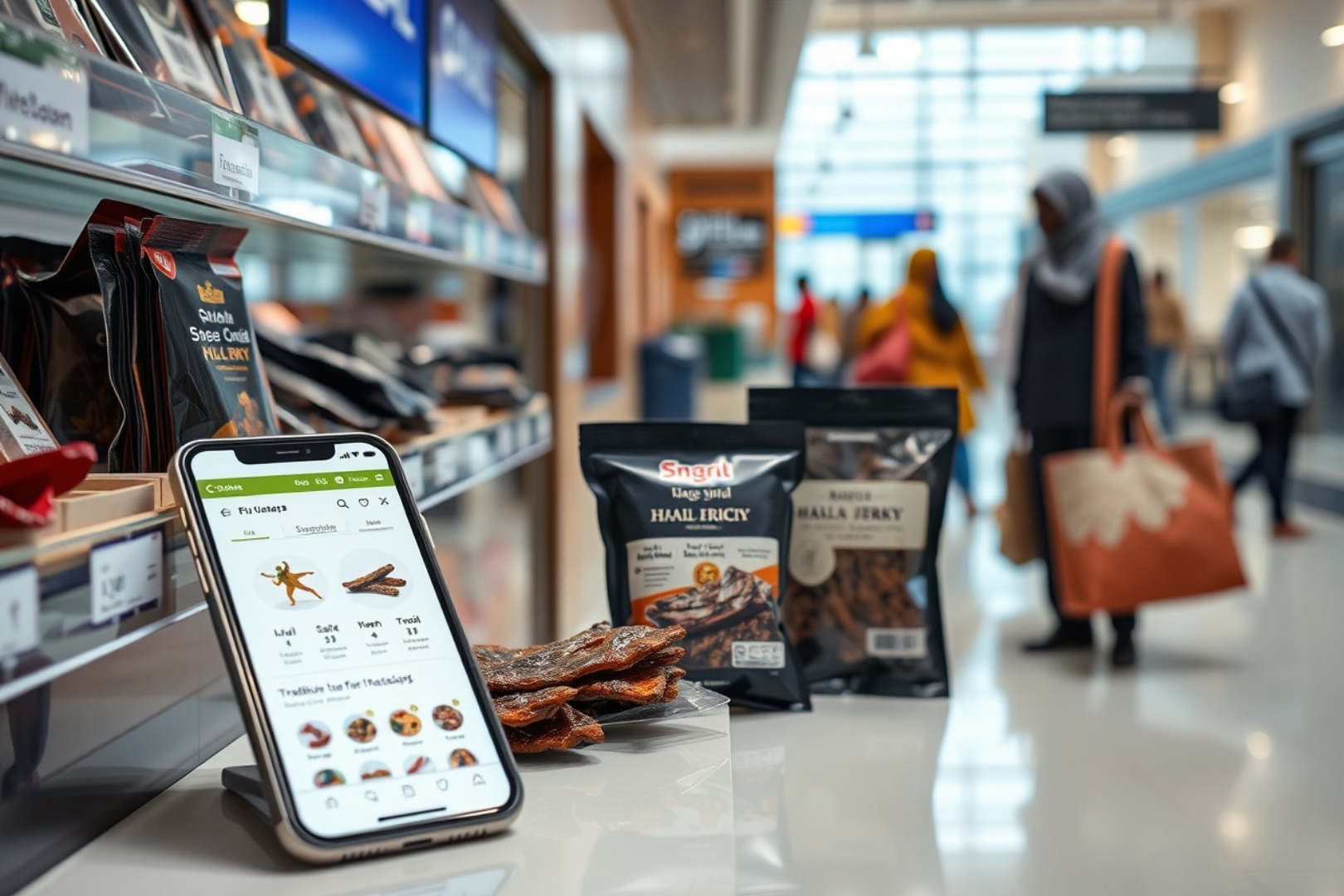
Hotels, airports, tourism businesses, and travel operators can use individually packaged halal meat snacks as convenient food options. This is particularly relevant where travelers need portable products with clear dietary information.
B2B
Hotels, catering businesses, corporate snack programs and distributors could become useful customers for larger multipacks.
Local flavors
One of the strongest product-development opportunities may be adaptation rather than imitation. A Cameroon-focused halal jerky market strategy could explore flavors influenced by familiar local seasoning traditions instead of simply copying American-style barbecue or pepper jerky.
Premium positioning
A premium halal product could compete on certification, packaging, traceability, and quality. However, halal status alone does not prove consumers will pay a premium.
That question requires actual price testing.
Challenges Facing the African Halal Jerky Market
The African halal beef jerky market faces several practical constraints.
Price
Jerky requires meat to be processed into a smaller finished quantity after moisture removal. So does African halal jerky. Beef costs, processing losses, packaging, and distribution can therefore make the finished product expensive relative to conventional snacks.
Certification
Certification provides trust but can add auditing, documentation, and operational requirements. Businesses must understand the applicable certification structure before making halal claims.
Food Safety
Drying reduces moisture, but it does not eliminate the need for food-safety controls. FAO notes that drying conditions and hygiene influence preservation, while research on Cameroonian kilishi demonstrates that traditional products can experience microbiological problems.
Processing Infrastructure
A scalable African halal beef market opportunity depends on more than livestock availability. Manufacturers need suitable processing facilities, reliable equipment, hygienic handling, packaging, and quality control.
Distribution
Jerky is fundamentally a convenience product. If consumers cannot find it easily, demand becomes difficult to build.
Consumer Familiarity
Consumers familiar with kilishi or biltong may understand dried meat but may not immediately understand a product marketed as Western-style “jerky.” Conversely, consumers unfamiliar with dried meat may require education.
Data Limitations
The biggest strategic challenge may simply be uncertainty. Public data does not currently provide a sufficiently reliable standalone estimate of the African halal jerky market.
Businesses therefore need primary research before committing significant manufacturing investment.
Future Outlook for the African Halal Jerky Market
The future of the African halal beef jerky market should be viewed through evidence rather than exaggerated forecasts.
Established Market Conditions
Africa has substantial Muslim populations, established livestock sectors, and long-standing traditions of meat preservation. Cameroon has a formal halal-food standard and an established dried-beef tradition. South Africa has a mature biltong category, while West African markets have established products such as kilishi.
Reasonable Commercial Interpretation
These conditions suggest that some African consumers may be receptive to professionally produced halal meat snacks, particularly where the product combines familiar flavors with convenient packaging and reliable halal assurance.
Cameroon is particularly interesting because the cultural concept of dried meat already exists. A modern product could therefore be positioned as an evolution of a familiar food category rather than an entirely foreign product.
Unproven Opportunity
What remains unproven is the size of the actual packaged African halal jerky market.
There is insufficient public evidence to claim that Africa has a specific market worth a particular number of billions of dollars, that Cameroon has a defined jerky-market share, or that halal jerky consumption will grow at a specific annual rate.
The sensible commercial approach is therefore to test the category.
A business considering African halal jerky could begin with small-scale consumer research, product testing, price experiments, and limited distribution before investing in large-scale manufacturing.
That approach is particularly appropriate in Cameroon, where the underlying conditions are interesting but the specific category remains under-measured.
Final Words: African Halal Jerky
The African halal jerky market should not yet be described as a fully established or precisely measurable industry. The available evidence supports a more cautious conclusion: Africa contains several market conditions that could support halal meat snacks, but the commercial potential varies significantly between countries.
The halal beef jerky market is particularly interesting where three conditions overlap: a meaningful Muslim consumer base, access to beef, and an existing culture of dried or preserved meat.
Cameroon fits this framework unusually well. Its Muslim population is substantial, its cattle sector provides a potential raw-material base, its national standards system includes halal-food guidance, and kilishi provides evidence that dried beef is already familiar in parts of the country.
For the broader African halal jerky market opportunity, traditional products such as kilishi and biltong may actually be more important than Western jerky trends. They demonstrate that consumers across different African regions already understand dried meat as a food category. The commercial opportunity may therefore lie in improving consistency, packaging, traceability, food safety, distribution, and halal verification rather than attempting to invent an entirely new eating habit.
For businesses, the African halal jerky market should therefore be treated as an input market rather than a direct measure of jerky demand. Likewise, the broader halal food market should be treated as context rather than proof of a large halal jerky market.
The strongest strategy is evidence-led: identify the target consumer, test flavors and prices, compare the product against traditional meat snacks, validate halal and food-safety requirements, and only then determine whether local production or imports make commercial sense.
In other words, the opportunity in the African halal jerky market may be real, particularly in markets such as Cameroon, but the business still has to earn the consumer’s money. Investors and businesses will certainly help develop the market in the near future.


0 Comments