
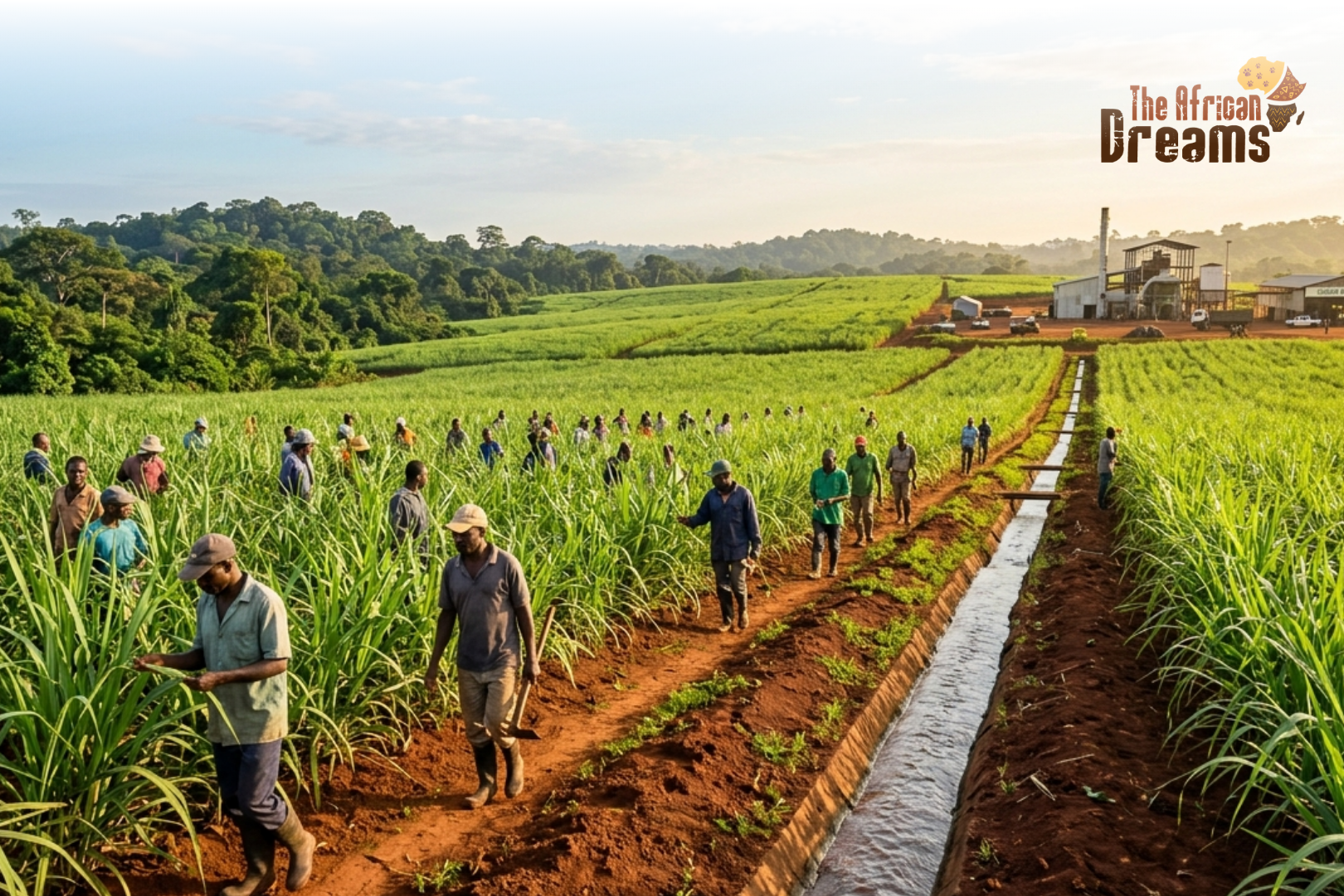
Introduction: Sugarcane Farming in Congo
The Republic of Congo has enormous potential for sugarcane, which also has uses in the food industry, biofuels, and bioplastics. In light of growing sugar demand worldwide, a significant development of the production of sugarcane under conditions of sustainability in Congo would be an important supporting function for the local economic development and food security.
On the other hand, being a highly water-intensive crop, sugarcane poses environmental challenges that need careful management. This case study explores the opportunities and challenges of sugarcane farming in Congo as it develops its sustainable sugarcane industry and identifies means whereby these can yield significant economic and environmental benefits.
The Challenges of Sugarcane Farming in Congo
Sugarcane has been regarded as one of the most water-consuming crops; it takes about 1,671 liters of water to produce 1 kilogram of sugar.
1. Due to climate change and the high demand for its production, sugarcane may increase the pressure on resources, especially in water-scarce areas like Congo.
2. Additionally, the conventional cultivation of sugarcane relies heavily on heavy doses of fertilizers and pesticides, which degrade the soil, contaminate the environment, and result in biodiversity loss.
3. Besides ecological pending problems, there are logistical and economic barriers to be overcome. Agriculture in the Congo suffers from a lack of up-to-date infrastructure, a shortage of agro-inputs or services available to farmers, as well as a lack of processing facilities—all factors contributing to high production costs and low output quality. In such conditions, the life of a local farmer is not so easy to compete against such strong positions as those taken by Brazil and India.
4. In addition, sugarcane farming in Congo is dominated by smallholder farmers who cannot invest much in the light of sustainability without government or other forms of external support.
The Solution
This would, therefore, involve the development of sustainable farming methodologies in line with prevailing environmental and economic conditions in Congo. The establishment of a resilient sugarcane industry would involve a number of mechanisms:
1. Climate-Smart Agricultural Practices: The introduction of furrow irrigation and practices of ratoon management will result in a significant reduction in the usage of water. Programs conducted in India and Latin America have already proved that precision irrigation techniques save billions of liters of water with yield increases of tons per hectare.
Application of similar techniques in Congo will help in streamlining water-sensitive farming of sugarcane while being resilient to changing environmental conditions.
2. Bioenergy and Product Utilization: Sugarcane, being a potent source of biomass, can have its by-products produce bioenergy and thus reduce the carbon footprint from the industry. If sugarcane bagasse is processed into biofuel, this will satisfy the local energy needs, minimize waste, and be a secure new revenue source.
The global bioenergy market is likely to reach 25% of the total energy supply by 2050, to which Congo’s sugarcane is expected to contribute, since it presents yet another green alternative to fossil fuels.
3. Sustainable fertilizer and soil management: Soil degradation should be addressed with the use of organic manure, crop rotation, and bio-fertilizers to enhance soil health and reduce chemical dependency.
Indeed, research has proved that methods of regenerative agriculture will help improve soil fertility and yields while reducing environmental impacts from sugarcane farming. Such practices may be adopted in Congo to develop a model that is sustainable for the land and local farmers.
4. Bonsucro Certification and Market Access: In positioning Congo among the best international standards, the Bonsucro Certification allows the country access to premium markets that require sugar obtained under conditions of sustainability. The Bonsucro Standard focuses on environmental and social sustainability in areas such as the use of water, labor rights, and communal engagement.
Farms that are certified can tap into the increasingly strong consumer demand for ethical products, thus enabling them to attract investments and partnerships with large global food and beverage firms.
5. Cooperative Farming and Community Investment: Smallholder farmers are the most underserved segment. Organizing them into cooperatives thus enables knowledge sharing, pooling of resources, and access to finance.
Cooperatives enhance farmers’ bargaining power, hence making it easier to secure fair prices, access to markets, and governmental support. In parts of West Africa, for example, smallholder farmers where cooperatives have thrived have recorded immense gains economically through sugarcane farming in Congo.
Implementation
The multistage road to sustainable sugarcane farming in Congo focuses on environmental, economic, and social perspectives.
1. Water-Efficient Infrastructure Investment: This shall include water-efficient irrigation systems, like drip or furrow irrigation, which will be the high-impact technologies for the farm. Such systems have been proven to save up to 30% more water compared to the traditional methods of irrigation. Because such systems will be invaluable in water-scarce regions, many governments protect and involve NGOs in the access to such technologies for smallholder farmers.
2. Construction of Processing Plants and Bio-Fuel Plants: The Government of Congo can definitely exploit all the by-products of sugarcane by building bio-fuel plants. Such plants will use bagasse from sugarcane to generate electricity, which would mean a reduction of waste and renewable fuels for rural communities to meet livelihood improvement with environmental sustainability.
3. Capacity-Building Programs for Farmers: Farmers can be assisted in the adoption of best practices by empowering them. Programs such as mobile training units reaching out to remote farmers, which have been conducted in India and South Africa, could be replicated in Congo. Other programs could weave in the economies of sustainability to ensure more prolonged adaptation of friendly techniques.
4. Government Policies and Incentives: Government incentives, such as taxes, subsidies on sustainable inputs, and water conservation-related rewards, will also encourage going green.
The government can enforce sustainable farming practices of sugarcane farming in Congo through its policies in support of these initiatives, ensuring those activities are implemented in due course. These initiatives will help to ensure that one day the Congo sugarcane industry emerges as a role model for eco-friendly agriculture.
The Results
With the implementation of sustainable practices in sugarcane farming in Congon, at least, quantifiable improvements in areas of productivity and environmental outcomes would be attained.
For instance, with climate-smart technologies, yield per hectare can be raised by 10-15%. This would imply improved incomes and enhanced food security for farmers. Besides, producing bioenergy from its by-products would remove dependencies on nonrenewable energy and hence would go through Congo’s commitment with respect to climate goals.
On the economic side, sustainable sugarcane farming would lessen the cost of inputs along the value chain, therefore making Congo’s sugarcane more competitive in world markets. With the opening of a market for certified, environmentally friendly products, Congolese sugarcane will also fetch premium prices and augment the profitability of the sector. Establishment of cooperatives and processing facilities will open up rural jobs, often very badly needed, further stimulating economic activity.
Final Remarks: Promoting Sugarcane Farming in Congo
Sugarcane farming in Congo stands at a crossroads, where its production can be transformed into a sustainable and value-added crop. The sugarcane industry could become one of the most influential drivers of economic integration with environmental responsibility by addressing resistance or resilience to weather changes, the use of resources in a sustainable manner, and cooperative farming models.
With sustained investment in sustainable methods of production, coupled with policy support, sugarcane farming in Congo will be able to improve its position as a leading player in eco-friendly sugarcane production. This will help meet the growing global demand for responsibly sourced sugar in the process.
In wind, sustainable sugarcane farming in Congo offers a unique path to economic development, coupled with much-needed conservation of its natural resources. These emerging opportunities will enable Congo to produce “sweetness” in a manner that is beneficial for the people, the economy, and the environment.

0 Comments