
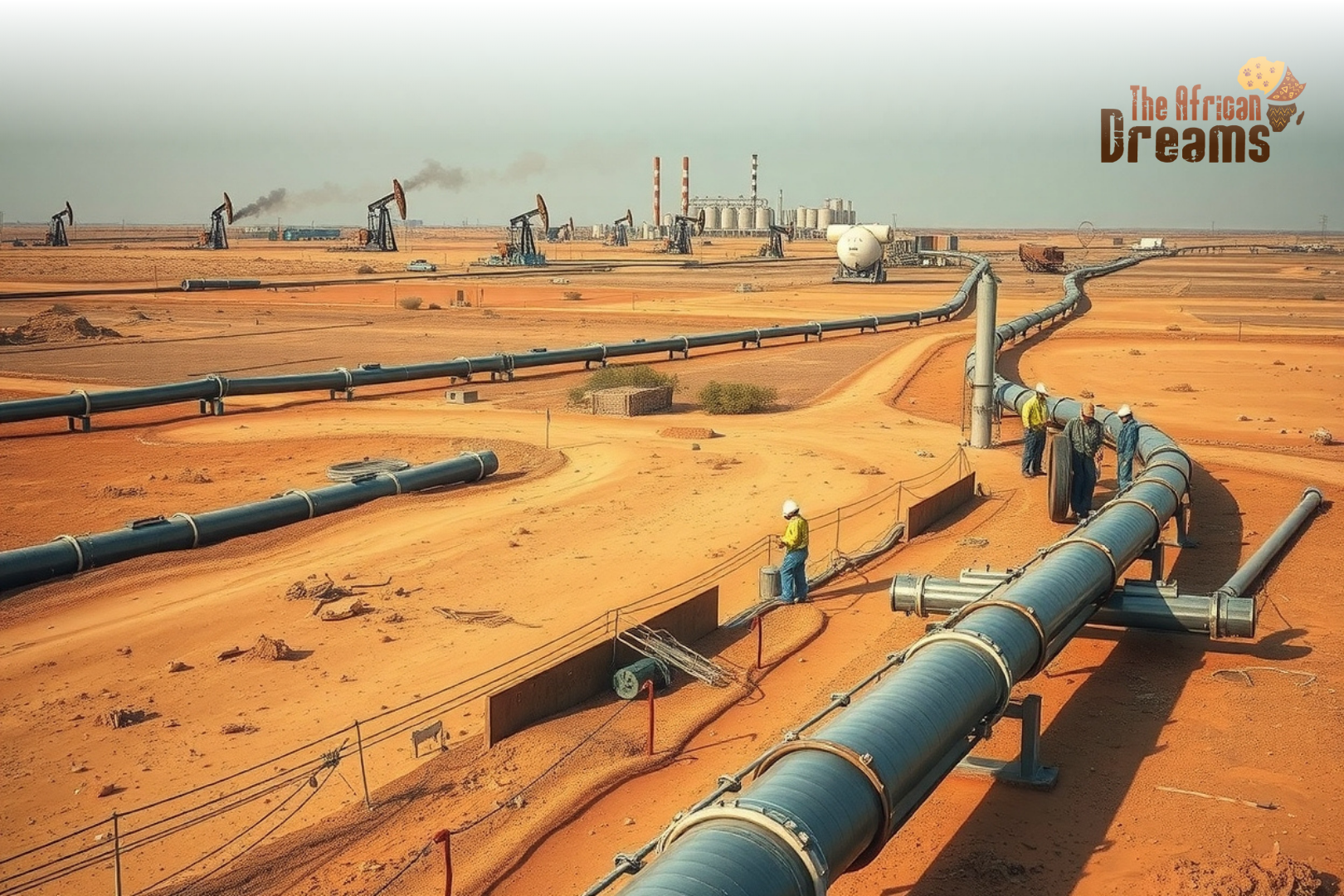
The Economic Lifeline of a New Era
What happens when a country teetering on the edge of economic collapse discovers a lifeline buried beneath its soil? In Sudan, oil isn’t just a resource- it’s hope. The discovery of oil in the 1970s was hailed as the savior of Sudan’s economy. Sudan’s oil production peaked in the early 2000s when it helped to develop pipelines and refineries. These projects helped ease the task of transporting oil to global markets. It generated jobs and stimulated local economies. Sudan’s GDP grew, fueled almost exclusively by the oil sector. Alliances set the stage for Sudan’s oil boom, paving the way for the next chapter of growth and opportunity. This blog will explore Sudan’s oil revolution and its future prospects.
Sudan's Oil Alliances
When oil was discovered in the Muglad Basin, the Sudanese government quickly embarked on several infrastructure projects with international partners. Sudan began exporting oil in 1999, a major accomplishment that ushered in a new era.
Sudan developed a strong tie to the oil industry, with significant interest coming from abroad, including China, Malaysia, and India. These were the countries that spearheaded the development of Sudan’s oil fields. Moreover, they furnished much of the long-term capital and technical know-how.
The rise to a promising oil-producing nation was also partly due to three arrivals into the market: China’s CNPC, Malaysia’s Petronas, and India’s ONGC.
These were not simple commercial deals. They were involved in strategic partnerships that brought technology, jobs, and investments to Sudan. The key to Sudan’s success in oil exploration and production was the construction of refineries, such as the Great Nile Oil Pipeline. Let us look at how and why this happened.
Laying The Building Blocks
Sudan’s oil boom has been a striking success, with billions poured into infrastructure in remote areas.
Pipelines transporting oil from the Melut Basin to Port Sudan helped export crude out of the region, providing an efficient conduit for revenue. The oil ports and refineries built as part of this infrastructure not only benefited the oil industry but also, by proxy, improved transportation networks and access in outlying areas.
Sudan’s geographic and political circumstances were demanding, and innovation was instrumental in confronting those challenges. This involved creating the refineries that could process those unique blends of crude oil found in the country, which is a major accomplishment.
For instance, the one in Khartoum was key to extracting the full value of Sudan’s petroleum-enabled oil refining locally instead of exporting crude only.
Environmental and social impact issues pose their own set of challenges as well. Oil extraction had other severe environmental and social impacts in the South than elsewhere, given its hydrocarbon riches. Because the displaced communities have been weeded out, yet some corrective actions have also tempered these impacts.
When oil companies, now under international oversight, began to announce their environmental obligations and social investments. Building schools and hospitals with oil revenues showed how oil money could be spent to benefit local communities, helping create social infrastructure.
Stories of Resilience in Sudan’s Oil Fields
Behind the vast networks of pipelines and the statistics fueling Sudan’s oil sector lies a deeply personal narrative—stories of people & communities trying to navigate the upheaval that has brought turmoil into their lives.
Traveling between the most remote villages and urbanizing cities, Sudanese citizens have come to live at a point where access meets resistance in their country, with such high potential as oil continues to remold it.
Consider Amira, a young geologist from one of the small villages outside El Obeid. She grew up on a farm, but her dreams expanded with the oil industry. Amira finished her education in Cairo. She thought she had to work abroad to support her family. But fortunately, she found work back home at the Muglad Basin oil fields, where Sudan made its first foray into petroleum exploration. Amira represents an extractive but developing cadre that views the sector as an avenue for financial independence and advancement.
Similarly, Ibrahim is a farmer in South Kordofan whose land was significantly altered by an oil pipeline built on it. His family had farmed this land for generations. But oil arrived and transformed the landscape and their economic future. Ibrahim evolved into a professional involved in pipeline maintenance. He created both job opportunities for his community and critical infrastructure upgrades. It is the story of a type of resilience where heritage mingles with new industry and one that meets modernization challenges head-on by taking matters into its own hands.
These stories remind us that each drop of oil flowing through Sudan’s pipelines carries the dreams and sacrifices of individuals like Amira and Ibrahim.
Future Prospects: Beyond Oil
As Sudan moves forward, questions remain about what is now the state of its oil sector.
Sudan is in a predicament as it tries to balance varying levels of production and maintain its competitive position in the global market while participating in the race for renewable energy that has taken over different markets worldwide.
This is the foundation upon which new growth can be built within the petrosphere.
Sudan has a lot of potential in sectors that are not conflict-prone, notably in agriculture and renewable energies. This wealth of knowledge and infrastructure can be translated to support these emergent industries beneath the surface, allowing Sudan’s resilient economy to adapt to global changes.
And the mistakes made by and lessons learned from the oil industry provide a unique opportunity to determine how Sudan can apply that experience to advance its economic development plans. To wrap it up: It has been a road of obstacles turned into success.
Conclusion
The case of Sudan’s oil industry is a story that weaves economic growth with political quagmires. Despite those challenges, the industry has seen some success stories we wanted to tell. Sudanese oil has played a significant role in shaping the history of its home nation.
While Sudan is still a work in progress, the oil industry has already left its mark and will continue to do so for years to come. Either through diversification or natural resources, Sudan will continue its journey with Oil. The stories of success in this sector do not speak only about oil. The tales are ones of mankind, human molding, resilience, and innovation backed by a never-say-die spirit to beat it all.

0 Comments