
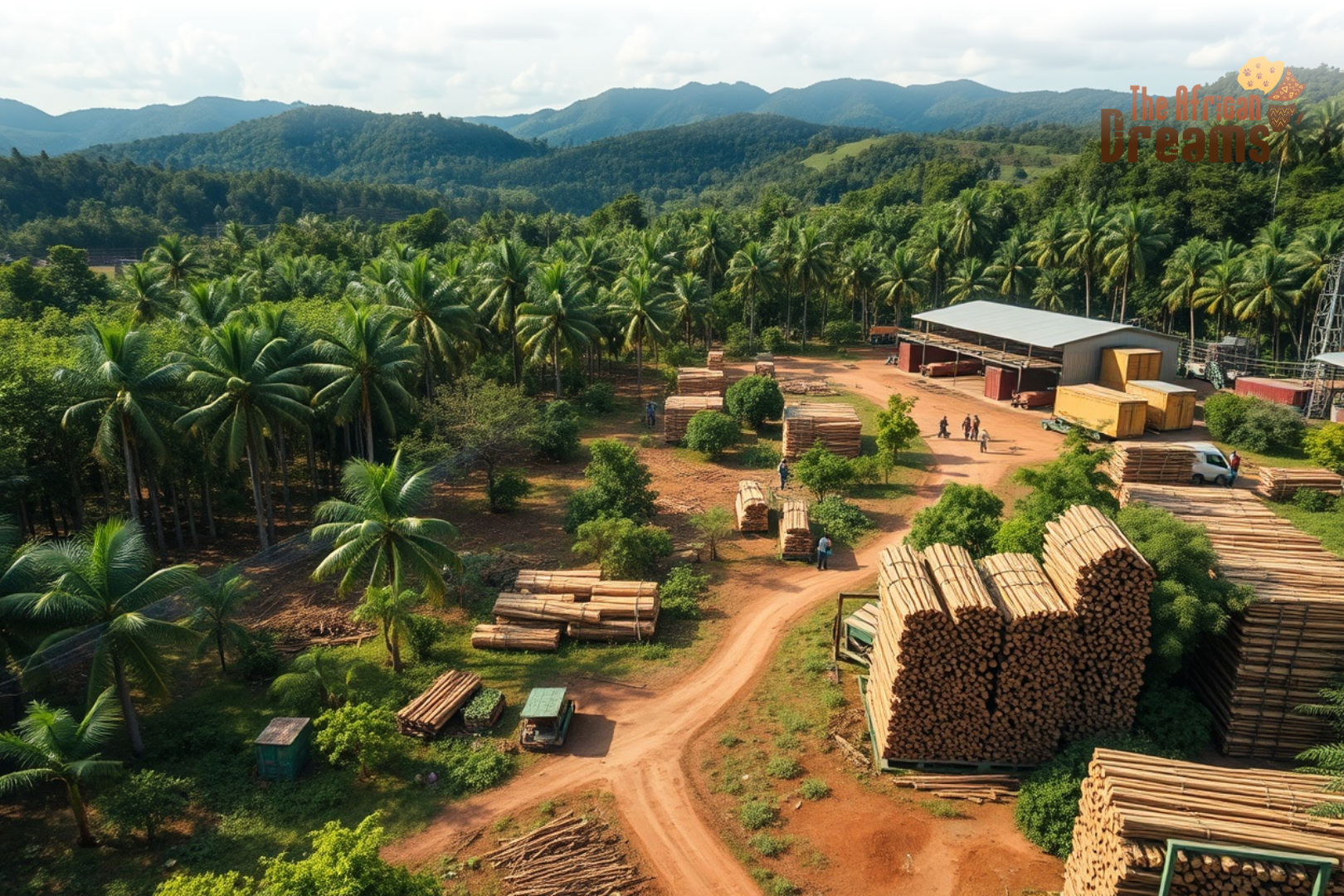
Introduction: Teak in the Congo
This case study looks at the teak industry in the Republic of Congo. The country has the potential for sustainability in harvest and export. Teak in the Congo is highly valued for its extremely durable and high-quality wood. It is in demand for furniture, construction, and luxury items globally.
Global demand places Congo in a strong but risky position when it comes to using its teak resources. The risks include illegal logging, lack of infrastructure, and weak regulatory frameworks. These challenges complicate matters for teak in the Congo. It ranges from sustainable forestry methods that have the potential to change the Congo teak industry to its environmental impacts and economic potential.
The Challenges in Teak in the Congo
Teak in the Congo faces many common problems:
1. Environmental degradation and illegal logging are among the factors prominent in threatening ecological stability and economic growth. In fact, it is estimated that 90% of the timber emanating from the Congo is sourced from illegal or informal sources. This indicates a poor implementation of forest management legislation.
2. Poor regulation contributes not only to deforestation but also to the loss of important revenues, undercutting legal enterprises and reducing the government’s capacity for reinvesting in forest conservation.
3. The country needs more infrastructure for wood processing. There are only about 15 sawmills around the key urban areas, with most of them concentrated in Kinshasa, Mai-Ndombe, and Kisangani. With such extraordinarily limited facilities, most teak goes abroad as raw logs. The country misses the value added that processed timber could bring in.
4. Legal and illegal logging operations rely so much on logging roads that these roads contribute to forest degradation and biodiversity loss; they fragment ecosystems and permit easier access to illegal activities.
5. Moreover, most forestry companies operating in Congo are foreign-owned, which entails more problems even as far as regulatory oversight is concerned. If not properly regulated through greater government and international organization intervention, teak in the Congo threatens to deplete resources without delivering significant economic benefits to the population.
The Solution to Improve Teak in the Congo
These challenges have stirred up various responses towards sustainable forest management within Congo. Among the major approaches is Reduced-Impact Logging (RIL), directed at minimal environmental impact with maximum yield.
RIL would involve the following practices: very careful harvest cycle planning, minimized road construction, and assurance that the logging rates will not exceed those of forest regeneration. This strikes a balance between ecological and economic interests and falls under the tag of sustainable teak production.
Besides RIL, various international organizations and programs, such as CAFI and the Congo Basin REDD+ program, have come forward to help Congo. They provide financial and technical support to local and national authorities in their efforts toward putting mechanisms in place for legal and sustainable forest management.
At the heart of such a program lies the Congo Forest Code, an outcome of Law No. 33-2020 mandating reforestation and regulated timber sourcing along with stringent policies on logging. It also obligates businesses, via the Forest Code, to process a substantial percentage of their wood extraction domestically, thereby generating employment and reducing dependence on raw log exports.
The role of technologies in monitoring and enforcing legality within teak in the Congo cannot be challenged. Congo is piloting traceability tools, such as the Timber Tracker, which have been tried with success upon trial in other African countries. This tool enables authorities to trace where the timber originates from, what path it takes before reaching the market, and where it finally ends up, thus making it easier to track locations where there are illegal logging activities and, as a consequence, prosecute these.
Improvement in traceability will also help the Congo demonstrate that its wood products originate from well-managed forests, adding to its reputation in environmentally-conscious markets worldwide.
Implementation
Therefore, addressing the nooks of sustainable practices of teak in the Congo requires coordination at multiple levels. This includes government agencies, international organizations, local communities, and the private sector.
1. Legal Framework Strengthening: With the new Forest Code adopted by Congo, very clear legal standards for timber harvesting have now been laid down, and at least 70% of the logs harvested must be processed locally. Wherever business compliance with this law is legal, government agencies ensure that it is checked every quarter to ensure that both local people and the forest benefit from the said activities and that they are sustainable.
It also creates, under the new Forest Code, Community Forests that assist local groups in managing the forest for their benefit by extracting timber in a sustainable manner.
2. Community Involvement and Capacity Building: Training local communities in the mechanics of sustainable harvesting forms the basis of success for any long-term process. Community forestry training programs equip residents with the skills of sustainable logging and wood processing. Above all, community-based jobs from these training programs are likely to develop a sense of ownership and responsibility for forest conservation.
On the other hand, artisanal operators trained in sustainable methods, for example, show improved yields and participation in formal economic structures that guarantee better income stability and social benefits.
3. Investment in Processing Infrastructure: With only a few sawmills across the country, investment in domestic timber processing capacity needs to be enhanced. More sawmills, rotary cutting units, and plywood factories can provide important value-added opportunities. Local timber processing will reduce raw log exports and create a supply chain within Congo for economic growth, resulting in job creation.
4. Improved monitoring and tracking: Law enforcers could use timber trackers to trace the sources of teak wood products, allowing crackdowns on illegal operations. Therefore, by following digital trails in wood products from forest to market, Congo can stay compliant with the legal framework and assure its international buyers of a sustainable product.
Traceability programs also represent a very important avenue through which financial institutions and consumers can actively support the emergence of sustainable timber sources.
5. Policy Incentives and International Partnerships: The Republic of Congo has incentives for companies and smallholders that set aside green areas for sustainable practices. These policy measures, for example, reduced taxes for legibly sourced timber and plantation forestry grants, incentivised compliance, and increased investment. Partnerships with organizations such as the World Bank, CIFOR, and TRAFFIC complement these through technical and financial support.
The Results
Indeed, the transition to sustainable forestry in Congo has begun to yield some promising fruits. The application of the Forest Code has led to better governance of the country’s forests, with reduced cases of illegal logging, as observed in monitored areas. Greater compliance with RIL guidelines has contributed to reduced deforestation rates, enabling forest regeneration and biodiversity.
Economically, it has become an attractive interest to eco-conscious markets, especially in Europe and Asia, where consumers are very willing to pay premiums for its wood sourced legally.
These benefits have also trickled down to the local economy, where investment in training programs and infrastructure for processing creates jobs in rural areas. Artisanal and small-scale producers act within a legal framework, receiving revenues and abiding by social clauses that help develop their communities.
This interest by international buyers in Congo’s teak underpins the market potential of teak in the Congo, which is sustainable and simultaneously sourced legally. Confidence is being won as Congo’s teak industry stands out in reputation and positions itself to become a reliable source of quality and sustainable wood, meeting global standards.
Final Words: Growing Teak in the Congo
Congratulations to teak in the Congo on this exemplary case of how focused reforms, partnerships, and community involvement have taken a complete turn in fortunes for that country’s natural resource sector.
As international demand is rising for responsibly sourced products, Congo now has the opportunity to convert its teak resources into effective, sustainable economic growth with the conservation of its forest ecosystems. With a commitment to sustainable forestry through investments in technology, updating legal frameworks, and participatory processes at the local level, Congo can lead in eco-friendly timber production.
Through continued efforts at compliance and sustainability, the teak in the Congo cements its position in high-value markets while contributing to environmental conservation and rural livelihoods. The successes so far portend a future when economic development and ecological preservation could stroll hand in hand to usher in sustainable prosperity across Africa’s Congo Basin.

0 Comments