
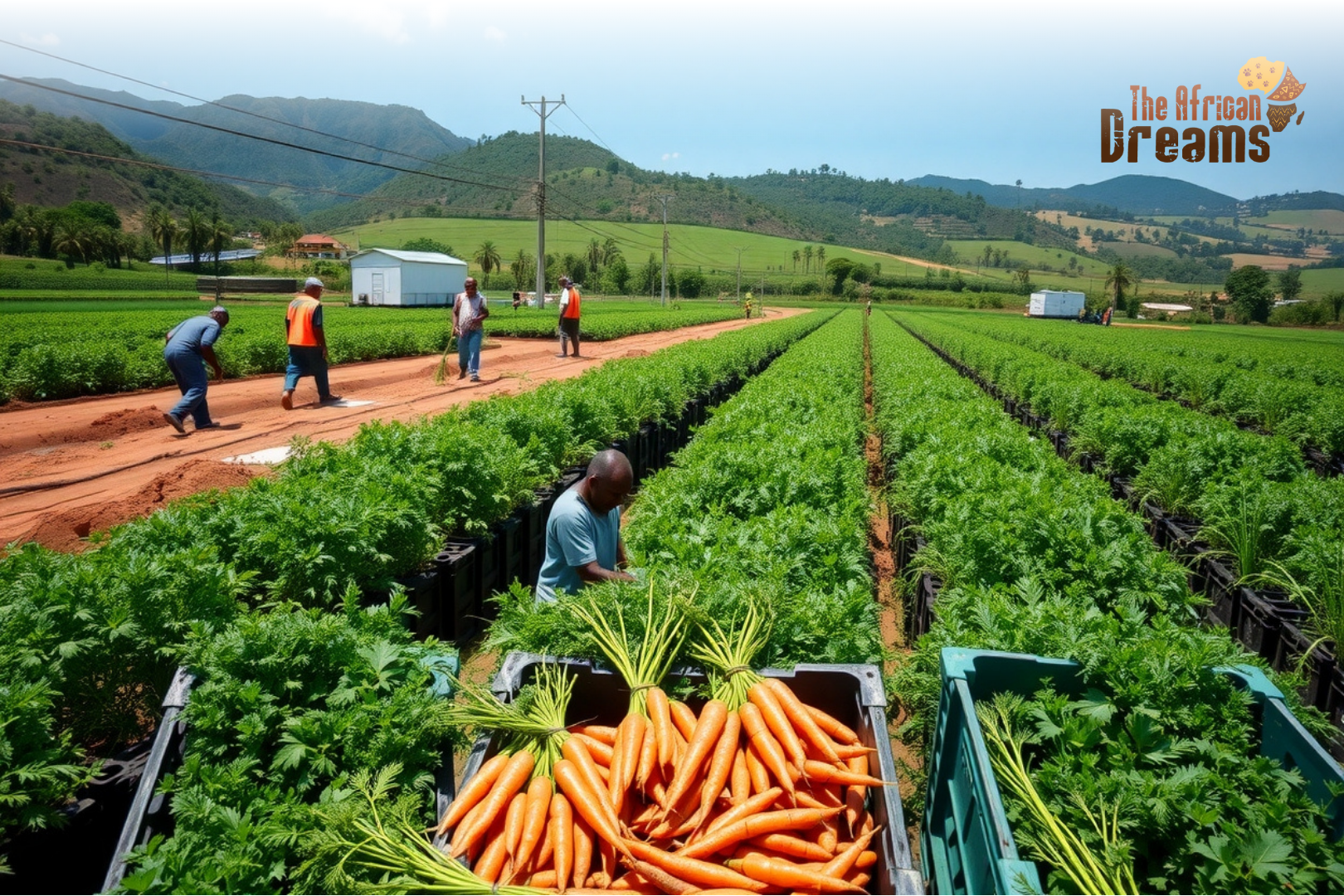
Carrot production is a growing but underdeveloped sector in the Congo’s agricultural sector. Because of its nutritional benefits and increasing consumer demand, carrot production is gradually becoming significant for food security. It also has a great impact on economic growth in Congo.
However, challenges like poor infrastructure, climate issues, and limited market access slow down its progress. In this article, we explore the current state of carrot farming, the problems farmers face and their solutions, and the future potential for growth in this industry.
The Challenges of Carrot Farming in Congo
1. Climate and Soil Suitability
Carrots prefer to grow in temperate climates with well-drained sandy soils. Unfortunately, these are not well represented in the Congo’s tropical environment. Also, most areas have very unpredictable rainfall and frequent flooding. This causes waterlogged soils to be beyond production capability.
Some highland areas may have cooler temperatures and appropriate soil conditions for such a root vegetable. Yet, the majority of the land lacks the right conditions for it.
2. Management of Diseases and Pests
Carrot plants are very susceptible to many pests and diseases. Carrot rust flies, nematodes, and fungi like leaf blight and black rot are major carriers of diseases.
All these, combined with a lack of modern technologies for controlling pests, contribute to substantial yield losses. Farmers’ lack of knowledge and resources in applying the integrated pest management approach lowers the productivity of carrot farms.
3. Market Access and Infrastructure
One of the major constraints for carrot farmers in Congo is the lack of reliable infrastructure that would transport the produce to larger markets. Most of the smallholder farming relies on roads that are in bad condition and impassable during the rainy seasons.
This is because, in the absence of cold storage facilities, they have to sell their crops immediately after harvest, often at low prices due to oversupply. Poor supply chains and post-harvest handling techniques result in huge losses amongst farmers.
4. Competition from Imports
Congo’s domestic production is very limited. Because of this, Congo imports most of its carrots and other vegetables from neighbouring countries.
Imported carrots are usually cheap and of high quality, reducing local farmers’ competitiveness. This has affected the growth of the domestic carrot farming industry.
This has stunted the growth of the domestic carrot farming industry and discouraged potential investment in the sector.
The Solution
Despite this, many measures are in place to improve carrot production in Congo: enhancing farm techniques, access to the market, and hence developing sustainable supply chains.
1. Improved Forms of Farming
Improvement in agriculture is one of the most crucial interventions required in the carrot sector of the Congo. Training for the farmers is being imparted to help them choose the right type of carrot variety that will suit their climatic conditions. For example, it has been ascertained that varieties such as Nantes and Danvers grow better in Congolese soil and climate conditions. These varieties are partially resistant to some pests and diseases and yield slightly higher. Hence, they would be ideal for the small-scale farmers.
Land preparation, including pH testing for good pH levels, has been advocated as a good practice and creates better yield carriers for carrots. Farmers are also using drip irrigation systems. This provides consistent moisture to the soil, thereby conserving even more water. It creates a situation that is most effective in places without regular rainfall
2. Cold Storage Facilities
Addressing post-harvest losses has to be the first step toward making carrot farming profitable. Solar-powered cold storage facilities are being introduced in rural areas. These facilities will help increase the shelf life of carrots and decrease total food spoilage.
This will provide the farmers with an opportunity to store their produce for a longer period. Thus, farmers will be able to sell their produce at better prices when an opportunity arises. Such facilities will also allow the farmer to supply carrots to supermarkets and food processors. This place requires consistent quality and a consistent supply of produce.
3. Market Linkages and Cooperatives
Therefore, experience has shown that farmers organised in cooperatives or agricultural clusters can access markets more easily and reduce transaction costs. Acting together, farmers can coordinate investments in transportation, storage, and marketing and thus find it easier to access urban markets.
Besides that, cooperatives bargain for better prices and even contract with buyers on behalf of farmers, reducing dependence on intermediaries who usually would pay low prices.
4. Infrastructure Investment
The government and private sector are launching initiatives to promote rural infrastructure for better movement of goods from farms to marketplaces. This includes road network development and cold-chain logistics to ensure vegetables, such as carrots, remain fresh right from production to the supply chain.
Improvement in infrastructure is also crucial for giving Congolese carrot farmers access to other markets, both regional and international.
The Implementation
Key actions to attempt to overcome these challenges and favour the development of the farming of carrots in Congo are as follows:
1. Farmers’ Training Programs
Training, usually spearheaded by NGOs and concerned government agencies, educates farmers about modern agricultural practices. They are also informed about improving soil health, managing pests, and irrigation techniques.
Farmers are also learning how to handle postharvest processes of cleaning, sorting, and packing their produce to market standards.
2. Adoption of Solar-Powered Cold Storage
Similar solar-powered cold storage facilities help small-scale carrot farmers in rural areas. They have been made affordable and energy-efficient, hence accessible even to most remote farming communities.
With these facilities, the bar for farmers’ incomes has increased, which encouraged more people in carrot farming, as they reduce spoilage and allow farmers to store their carrots for a longer period.
3. Market Access Expansion
Efforts are underway to link carrot farmers to bigger and more lucrative markets. Direct sales to supermarkets, food processors, and restaurants have already been established, giving the farmers better prices for their produce.
This has also opened new ways of selling fresh vegetables directly to consumers through online marketplaces and digital marketing platforms.
The Results
Indeed, the combination of improvements in farming techniques, infrastructure, and market linkages has generated benefits for carrot farmers in Congo. Yields have mounted, and post-harvest losses because of cold storage usage have dulled considerably.
This has made carrot farming more lucrative, encouraging smaller-scale farmers to diversify their produce to include carrots. Higher-income levels result from increased access to larger and more profitable markets.
Farmers can gain better prices for their produce without intermediaries through direct sales to supermarkets and food processors. Notably, the increased demand for carrots, both on the domestic and regional levels, has spurred farming, processing, and logistics jobs.
Conclusion
The carrot farming industry forms the very core of the great transformation that Congo is about to see in its vegetable market. Indeed, there is a big opportunity for continuous investment in infrastructure. Training and market linkages also help Congo develop a strong and thriving carrot farming sector. They can form the basis for both food security and economic growth.
The farmers will adopt modern farming technologies coupled with access to facilities such as cold storage. That’s why the growing of carrots in Congo must emerge fast.
By investing in and supporting the right initiatives, Congo can decrease its reliance on vegetable imports from other nations and grow its internal capacity for vegetable production. It is at that time when income for small-scale farmers will increase as good nutrition and improved food security take root in every corner of the land.
Therefore, it is a bright prospect for a future in carrot farming in Congo, which could be nurtured into an integral pillar of Congolese agriculture.




0 Comments