
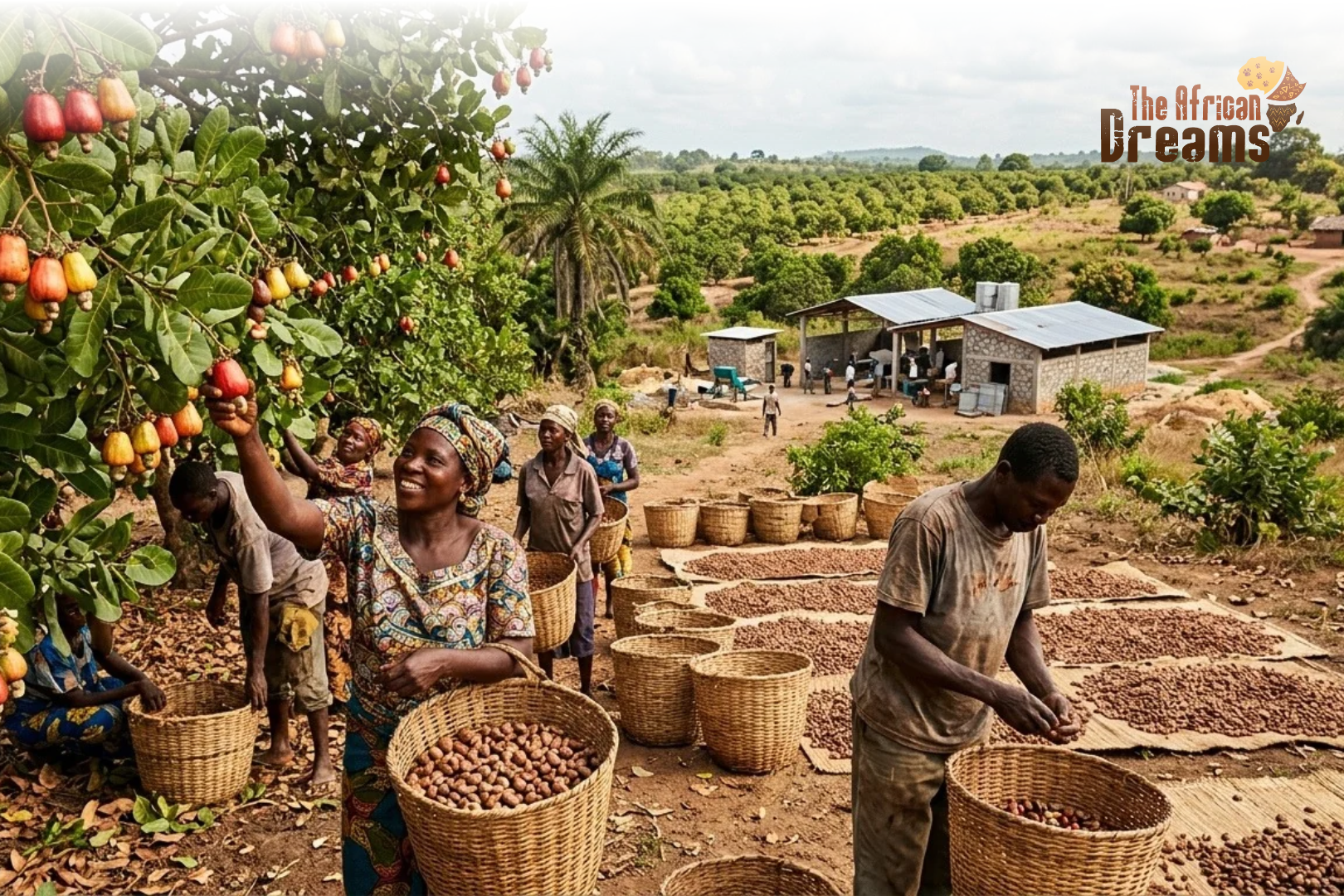
Introduction: Guinea-Bissau’s Cashew Nut Industry
Cashew nuts, a simple, tiny nut, are creating thousands of benefits in the economic system and a better lifestyle for many people. Guinea-Bissau’s cashew nut industry has expanded its journey by increasing from 200 tons in 2022 to an expected 500 tons in 2023; another has made 26% of her annual income from cashew farming. More successful stories like these are increasing in number in Guinea-Bissau.
Guinea-Bissau was the 16th largest value cashew nut exporter in the world, worth $68.5 million, accounting for about 1% of the world’s exports of cashews in 2023. The government of Guinea-Bissau has been increasingly focusing on the cashew nut sector, knowing of its colossal contribution to the nation’s economy. Investors are also trying to enhance this sector. This article is about Guinea-Bissau’s cashew nut industry and how investors can invest here.
Article Highlights:
Guinea-Bissau is the world’s 5th largest cashew nut producer and 16th largest cashew nut exporter.
Guinea-Bissau’s cashew nut industry contributes over 80% of rural incomes and exports in the country. It is the 16th largest cashew nut exporter in terms of value among the world’s largest producers and is ranked 5th in the world.
Production rose from 200,000 metric tons in 2023 to 220,000 in 2024. The primary production regions are Oio, Bafatá, Cacheu, Quinara, Tombali, and Biombo.
The key problems in Guinea-Bissau’s cashew nut industry are infrastructural shortages, lack of finance, inefficient processing capacity, value chain dispersal, and archaic farm methods. Solutions include upgrading rural infrastructure, micro-financing for cashews, decentralized processing plants, web-based direct marketing websites, and farm-level training programs.
Programs like the LIFFT Cashew Project and GANADU Cooperative are transforming the business. Real-life experiences like Fatima’s provide an understanding of how Guinea-Bissau’s cashew nut industry and cashew cultivation are changing lives.
Cashew cultivation is in demand more and more around the globe, with big opportunities. Through proper investments, Guinea-Bissau’s cashew nut industry will double its returns within five to five years.
Overview of Guinea-Bissau’s Cashew Nut Industry
Cashew nuts are Guinea-Bissau’s principal cash crop. They are among the world’s largest producers of cashew nuts and are ranked 5th in the world. Cashews are the backbone of the Guinean-Bissauan economy, between 80% and 90% of total exports are cashew nuts. It accounts for more than 80% of rural households’ domestic income, directly or indirectly.
The primary harvest season is from March to June, and the central production locations are Oio, Bafatá, Cacheu, Quinara, Tombali, and Biombo. Guinea-Bissau raw cashew nuts are the best in the world. Production Quantity per year is approximately 200,000 metric tons of raw cashew nuts. Production Volume in 2023 was approximately 200,000 metric tons of raw cashew nuts. Raw cashew nut production in 2024 was approximately 220,000 metric tons. There is an increasing rate of production.
Types of Cashew Nuts Produced in Guinea-Bissau
Raw Cashew Nuts (RCNs): This type is the primary cashew nut produced and exported by Guinea-Bissau. Cashew nuts are harvested, dried, and marketed in shell form, raw and unprocessed. The raw nuts are mainly exported to major processing countries such as India, Vietnam, and Portugal. Guinea-Bissau raw cashews are highly valued as they possess the best qualities, including a high Kernel Outturn Ratio (KOR) of between 46 and 48 pounds per 80-kilogram sack bag, which by global standards is excellent.
The nuts are also of high count per kilogram and are relatively large compared to most other African countries’ produce. In addition, Guinea-Bissau’s cashew nuts are generally grown naturally with minimal or no chemical use, which qualifies them as similar to organic quality. This quality dominates the nation’s cashew business, making up 95% to 98% of the total production.
Cashew Kernels: The second type produced, though at a tiny scale, is Cashew Kernels. Less than 5% of Guinea-Bissau’s cashew nut production is locally processed into ready-to-eat kernels for direct consumption by snack industries and food processing companies. The current local factories manufacture high-quality White Whole Kernels, such as WW320 and WW240, and broken kernels, which are extensively used in bakeries and confectioneries. Although in its infancy, the cashew processing industry has tremendous potential for expansion if investment in it continues to grow.
Cashew Nut Shell Liquid is not any kind of liquid; rather, it is the cashew shells containing a valuable oil known as CNSL, which has widespread industrial applications in paints, brake linings, lubricants, and plastics. In Guinea-Bissau, however, CNSL extraction has yet to be commercially developed on any notable scale. Establishing shell processing plants for CNSL production offers an excellent future opportunity to diversify cashew byproducts and enhance the overall value of the cashew industry.
Real-life Successful Stories of Guinea-Bissau's Cashew Nut Industry
The environment and soil of Guinea-Bissau are suitable for cashew farming, so many organizations started their journey in cashew farming, which is now inspiring others. Such real-life success stories are inspiring and part of building the economy.
1. LIFFT Cashew Project: The LIFFT Cashew Project is a core successful story Linking Infrastructure, Finance, and Farms to Cashew. It is funded by the United States Department of Agriculture (USDA) and has played a key role in restructuring Guinea-Bissau’s cashew nut industry.
The initiative set out to advance farm-level output, strengthen cooperatives, access finance, and improve infrastructure for cashew trading. Among its key achievements was instructing over 5,000 farmers on Good Agricultural Practice (GAP), a strategy that instantly raised yield, improved nut quality, and improved disease resilience to produce competitive exports.
The project formed or reinforced 12 cooperatives countrywide, which have enrolled more than 6,500 active members. Cooperatives are now important forums through which farmers collectively negotiate better prices and access to the market. A combined nearly 94,000 metric tons of raw cashew nuts were marketed through cooperatives supported by LIFFT, leading to significant gains in rural livelihoods that heavily depend on the production of cashews.
In 2023, the project enabled the release of over $1.2 million in loans to cashew processors. This enabled local processors to purchase directly from farmers, constructing domestic value chains and reducing reliance on exploitative intermediaries.
2. GANADU Cooperative: This is another example of Expansion and Innovation. The GANADU Cooperative in the Bafatá region exemplifies local dynamism and strategic expansion in cashew production. GANADU expanded its activities exponentially from 200 metric tons in 2022 to the anticipated 500 metric tons in 2023. Such significant expansion reflects enhanced farm management, cooperative marketing, and technical capacity building.
After realizing the value of moving from raw exports, GANADU will set up a local processing plant. Processing locally will allow them to benefit from enhanced profit margins and diversified sources of income for members. Understanding the risks of rural depopulation, the cooperative has successfully engaged local youth in the cashew value chain, from production and harvesting to marketing and small-scale processing activities. This generates jobs and builds the next generation of agricultural entrepreneurs.
3. Story of Fatima: Stories created by sole effort are also included. The Fatimas personify the local face of the cashew economy. Fatima is a single mother who depends on cashew farming for approximately 26% of her annual income. Despite long-standing issues like fluctuating cashew prices, lack of access to farm inputs, and market uncertainties, she still maintains her farm.
Challenges in Guinea-Bissau's Cashew Nut Industry:
Despite this increase in production and these successful ventures, there are many challenges still hampering the production capacity of Guinea-Bissau’s cashew nut; issues arise such as:
1. Poor Infrastructure: Bad roads, storage facilities, and port handling make the transportation of cashews sluggish and result in heavy post-harvest loss. This could be improved, and better roads and storage would prevent loss and increase exportable volume by a minimum of 15%-20%.
2. Financing Constraints: Small cooperatives and farmers cannot borrow inexpensive loans to buy equipment, fertilizers, or expand farming. Credit availability may allow farmers to plant more trees, more efficiently maintain the ones they have, and increase output by 20% to 30%.
3. Low Local Processing Capacity: Almost all of Guinea-Bissau’s cashew nuts are exported raw; less than 5% are processed locally. Establishing processing factories would double or triple sector revenue, even if production volume remains unchanged.
4. Disaggregated Value: They sell to various intermediaries who reduce their margins. Farmers are less encouraged to produce more because they get unfair prices. Better farmer-exporter direct contracts and cooperative strengthening can increase farmers’ incomes by 20% to 30%, resulting in higher farm investment.
5. Deficient Farming Practices: Most cashew farms are old and degraded. Farmers are not trained in new farming practices (e.g., pruning, pest control, tree rejuvenation). Adopting Good Agricultural Practices (GAP) would enhance farm productivity by 30% to 40%.
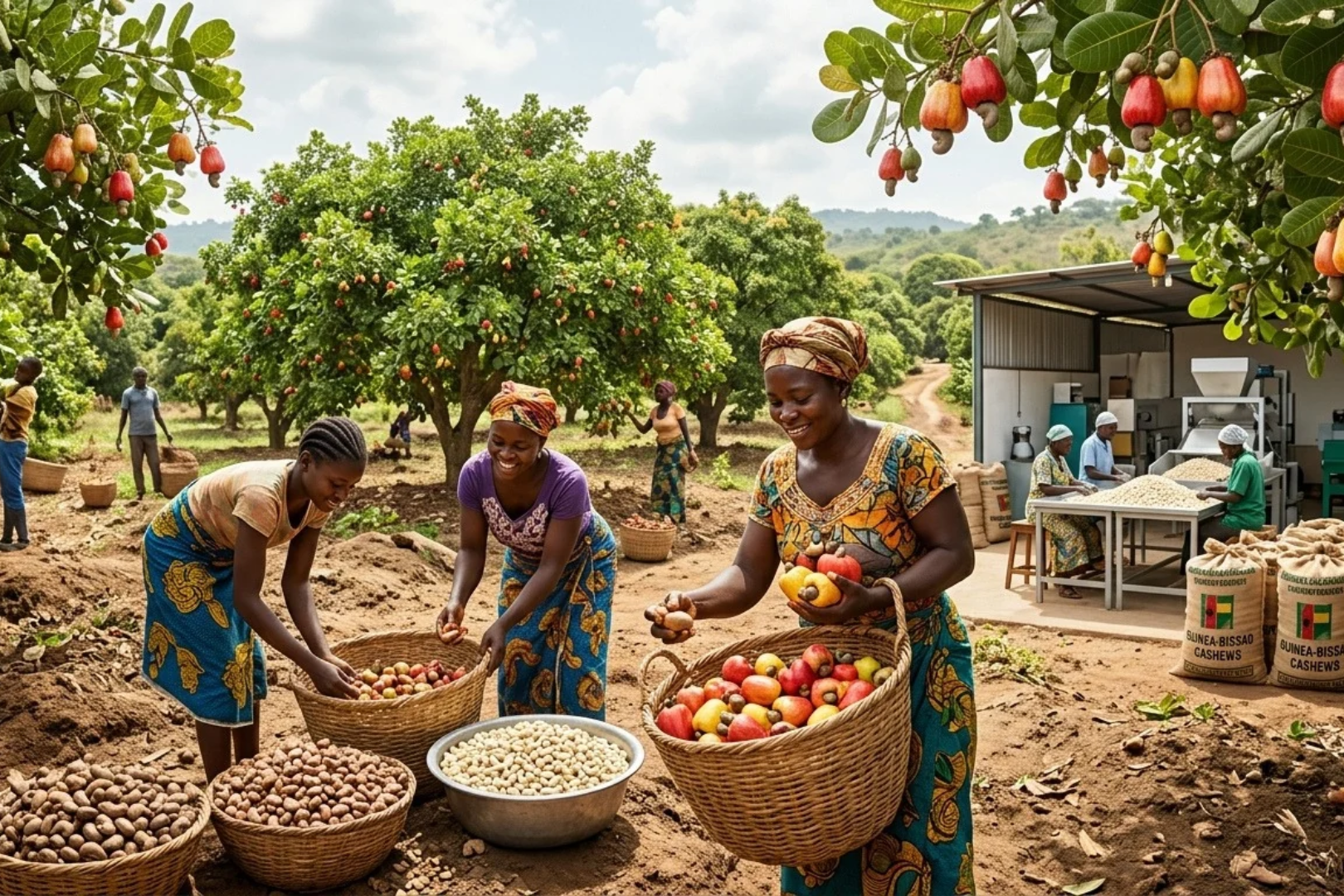
Solutions for Developing Guinea-Bissau's Cashew Nut Industry:
Investors can play a significant role in solving the problems faced by Guinea-Bissau’s cashew nut industry. As there are low-rate farming practices, investors can create a hub to educate farmers by setting up their own farms. This initiative will do both types of work, as investors can train the farmers while earning from their farms.
Besides investing in infrastructure development, such as improving storage facilities, there is a chance to improve the current situation. Other solutions, such as
1. Creating an online direct-to-export platform here cooperatives upload cashew availability and exporters can bid directly can be another approach.
2. Creating cashew microfinance programs offering loans and crop-backed borrowing facilities to cooperatives and farmers.
3. Creating mini-processing factories close to the farms and encouraging private investment in cashew industrial parks.
4. Developing direct farmer-to-exporter websites and strengthening cooperatives to enable farmers to market collectively at enhanced prices.
5. Introducing national GAP training and promoting cashew tree renewal projects involving high-yield varieties.
Why Someone Should Invest in Guinea-Bissau's Cashew Nut Industry
The country produces some of the best raw cashew nuts in the world, with high kernel outturn ratios (KOR), which is precisely what foreign customers are looking for. Less than 5% of the cashews are locally processed; a tremendous value-add opportunity waiting to be tapped. Guinea-Bissau’s pesticide-light organic cashew farming perfectly matches high-value world market trends.
There are guarantees of minimum prices and tax exemption on agribusiness investment available in Guinea-Bissau. World Bank, African Development Bank, USDA, and EIF-initiated projects exist. Labor and land costs in Guinea-Bissau’s cashew nut industry are much lower than operating expenses in Vietnam, India, or Brazil.
The export volume of cashew nuts was approximately 163,000 metric tons in 2023, and in 2024, the export volume increased to 166,000 metric tons, the highest ever in the past five years. The largest and most important market is India, purchasing 60% to 70% of all cashew shipments from Guinea-Bissau. The second most important market is Vietnam, a central world hub for cashew processing. Portugal is an important market. China is also a developing market for Guinea-Bissau’s cashew shipments. Singapore is a vital re-export hub. Although Singapore does not use a lot of cashews, it imports nuts for sorting according to quality, repackaging, and reexporting them to other Asian and Middle Eastern nations.
Final Words: Developing Guinea-Bissau's Cashew Nut Industry
The demand for Guinea-Bissau’s cashew nuts is increasing, and despite some problems, the production amount does not decrease. Moreover, the export volume is also growing. The statistics say they have utilized the full capacity.
Both global and local investors can create jobs for the farmers, significantly impacting the economy while ensuring profitable business. Upgrading rural infrastructure, micro-financing for cashews, decentralized processing plants, web-based direct marketing websites, and farm-level training programs can help improve and grow Guinea-Bissau’s cashew nuts industry.
New investors can follow the path of successful stories or make their own successful stories.
FAQs (Frequently Asked Questions)
1. Why is cashew cultivation necessary for Guinea-Bissau?
Cashew cultivation is Guinea-Bissau’s economic pillar, providing 80%- 90% of the country’s total export revenues and employing 80% of rural communities.
2. Why are cashew nuts in Guinea-Bissau unique?
Guinea-Bissau’s cashew nuts have a global image due to their elevated kernel outturn ratio (KOR), organic natural content, and larger nut size, which have made them highly sought after globally.
3. Quantity of raw cashew nuts annually exported by Guinea-Bissau overseas
Guinea-Bissau shipped around 200,000 metric tons of raw cashew nuts in 2023; subsequent production rose to around 220,000 in 2024.
4. What are the main challenges facing Guinea-Bissau’s cashew nuts industry today?
The most significant challenges are the lack of rural infrastructure, short-term finance, local processing capacity, dependency on intermediaries, and archaic farming methods.
5. How are the challenges being dealt with?
Modernizing warehouses and roads, launching microfinance schemes, setting up local processing units, building farmer-exporter websites, and making farmers aware of improved farming practices are addressing these challenges.
6. Are the industry, government, and foreigners assisting it?
The government has established floor prices, and organizations like the World Bank, USDA, and EIF are heavily investing in the industry.
6. Is there an investment opportunity in Guinea-Bissau’s cashew business?
Yes. Plant growing, processing facilities, supply centers, organic certification programs, and technology-based marketplaces are opportunities.
7. Why would foreign investors invest in Guinea-Bissau?
Guinea-Bissau has arable land, low operational costs, rising output, idle processing capacity, international demand for cashews, and a good government policy environment.
8. Any success stories in Guinea-Bissau’s cashew nuts business?
LIFFT Cashew Project educated more than 5,000 farmers and registered sales of 94,000 tons; GANADU Cooperative increased production by 150% in a year; individual farmers such as Fatima have substantially boosted household incomes.
9. What are the prospects of Guinea-Bissau’s cashew nuts sector?
With proper investment, public-private partnership, and innovation, Guinea-Bissau can become a value-added cashew world leader in 5–7 years.
10. When is Guinea-Bissau’s cashew nuts harvest season?
Every year, the cashew harvest season is from March to June. During this time, most of the country’s rural population harvests and markets cashews.
11. What is Guinea-Bissau’s cashew nuts farm’s average hectare yield?
The yield ranges from 400 kg to 600 kg per hectare, depending on the agricultural method, the age of the plantation trees, and the prevailing weather.
12. Guinea-Bissau’s cashew nuts: what proportion is processed locally?
Fewer than 5% of raw cashew nuts are currently processed domestically. They are mainly exported green to India and Vietnam to be processed.

0 Comments